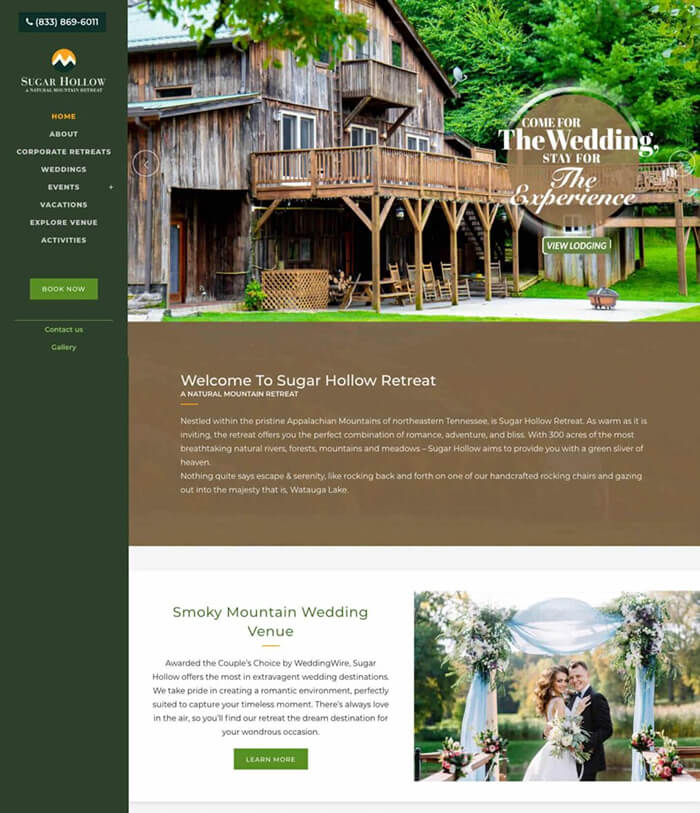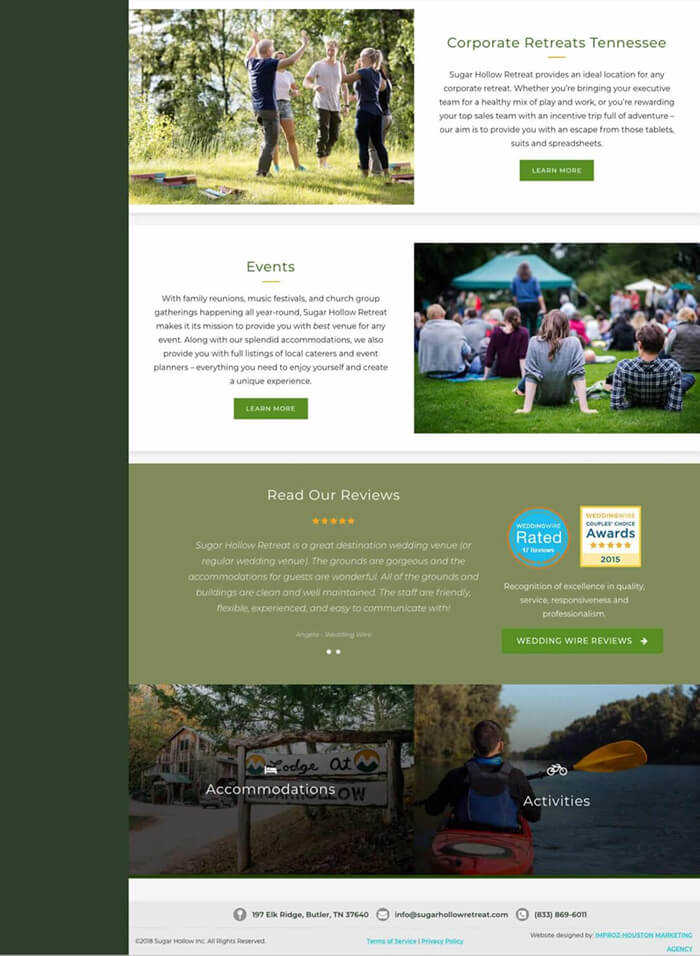
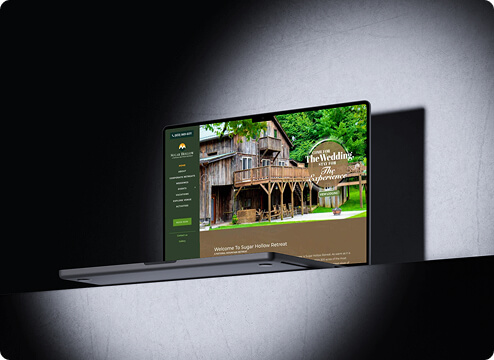
Sugar Hollow was the kind of place people traveled to experience.
Nestled in the Smoky Mountains, the wedding venue offered something difficult to communicate through ordinary service-page copy alone: scenery, atmosphere, privacy, and the feeling of getting away somewhere special to be married.
That beauty also created the marketing challenge.
Sugar Hollow was a local business, but its best audience was not limited to people living nearby. Couples could discover the venue from cities and states away and still consider it for their wedding.
So the strategy could not revolve around proximity alone.
We needed to understand the venue as a destination, capture what made the experience special, and build a marketing system capable of reaching couples well beyond the surrounding community.
Built a digital strategy around Sugar Hollow as a destination wedding venue, not simply a local business
Traveled to the Smoky Mountains and spent a weekend at the property to experience the venue firsthand
Captured original photography and video to communicate the setting and atmosphere authentically
Used that firsthand experience to guide website design, messaging, and content
Developed search strategy around wedding and destination intent rather than depending entirely on proximity-based local SEO
Ran Google Ads to reach couples demonstrating active wedding-venue search intent
Used social media advertising to introduce the venue visually to prospective couples beyond the immediate market
Connected website design, content, search, paid media, and original creative assets around one central idea: make people want to travel to Sugar Hollow
Industry: Wedding Venue / Hospitality
Services Provided: Website Design, SEO, Content Strategy, Photography, Video, Google Ads, Social Media Advertising
Goal: Build a digital presence capable of communicating the Sugar Hollow experience and reaching prospective couples beyond the venue’s immediate geographic market.
Traditional local marketing often starts with a reasonable assumption:
Find the people near the business who are searching for what the business offers.
That model did not fully fit Sugar Hollow.
The venue was physically located in the Smoky Mountains, but prospective customers did not have to live nearby. A couple could be researching wedding venues from another city—or another state—and still be willing to travel for the right location.
That meant the immediate population around Sugar Hollow was only one part of the opportunity.
The real market was wherever couples were considering the Smoky Mountains, mountain weddings, destination weddings, and memorable places to get married.
For many local businesses, proximity can strongly influence who becomes a customer.
A person looking for a dentist, plumber, restaurant, or salon usually has practical limits on how far they are willing to travel.
Weddings behave differently.
Couples may intentionally search beyond their own community because the location itself is part of the experience they are choosing.
For Sugar Hollow, a strategy built primarily around being the closest venue would have missed an important part of the market.
We needed to think beyond:
“Who is searching for a wedding venue near Sugar Hollow?”
and consider:
“Who is looking for a wedding experience that Sugar Hollow can provide?”
Sugar Hollow was not simply a building where a wedding could take place.
The surrounding mountains, scenery, atmosphere, and sense of escape were part of what made the venue worth considering.
That created another challenge.
A prospective couple might encounter Sugar Hollow online long before ever setting foot on the property.
The website and marketing therefore had to do more than provide information.
They needed to help someone begin to feel the place.
Our strategy started by recognizing that Sugar Hollow could not be marketed effectively from a distance.
Before we could communicate the venue, we needed to understand it.
We traveled to Sugar Hollow and spent a weekend at the property. We walked the venue. We experienced the landscape. We saw the views prospective couples would see. We paid attention to the surroundings, the atmosphere, the physical spaces, and the details that made the location different from an ordinary event facility.
During that visit, we photographed the property and shot video that could be used throughout the marketing. But the trip produced more than creative assets. It gave us context.
That firsthand experience influenced how we wrote about the venue, which elements we emphasized, how we approached the visual design, and how we thought about the customer journey. Instead of trying to interpret Sugar Hollow through someone else’s description, we had experienced the place ourselves.
The website needed to communicate practical information, but that alone was not enough.
Prospective couples needed to be able to imagine themselves there.
Photography, video, copy, and design worked together to communicate the broader experience of the venue.
The goal was not simply:
“Here is a place where weddings are held.”
It was closer to:
“Imagine getting married here.”
That distinction shaped the design.
The setting could not be treated as decoration surrounding the service.
The setting was part of the service.
Sugar Hollow reinforced an important distinction in search marketing:
Geography matters, but geography does not always mean proximity.
For a typical local campaign, visibility within a defined service area may be one of the primary objectives. For a destination wedding venue, the audience can be distributed far beyond that area. Search strategy therefore had to consider the intent behind the search—not simply the physical location of the person performing it.
People researching mountain weddings, Smoky Mountain wedding venues, destination wedding possibilities, or a particular type of ceremony experience could be relevant even if they were nowhere near Sugar Hollow when they searched.The challenge was connecting the venue to that broader intent.
Organic search was only one path to the audience.
We also ran Google Ads.
Paid search gave us a way to reach couples who were already demonstrating commercial intent through the searches they performed.
Instead of waiting for every organic opportunity to develop, advertising allowed Sugar Hollow to compete for attention during active wedding-venue research.
That was particularly valuable because the market was not confined to a small local radius.
Search advertising and social advertising served different roles. Google Ads could connect Sugar Hollow with people actively looking.
Social media gave us an opportunity to introduce Sugar Hollow to people through the very thing that made the venue compelling:
the visual experience.
Wedding decisions are highly visual. Original photography and video allowed the venue to appear in front of prospective couples as something to discover, imagine, save, share, and consider—even before they had specifically searched for Sugar Hollow. In that sense, search could capture existing demand while social media helped create awareness and desire.
Because we had captured the venue ourselves, the website and advertising did not have to depend entirely on generic descriptions or detached creative assets.
The images, video, writing, and design all came from the same understanding of the place.
That created consistency.
The ads could introduce the experience.
The search campaign could capture intent.
The website could continue the story.
And the creative assets could help make the destination tangible to someone sitting hundreds of miles away.
Marketing becomes weaker when everyone involved is interpreting the business secondhand.
Our weekend at Sugar Hollow allowed us to see details that would have been difficult to understand from a questionnaire or phone conversation alone.
That understanding affected:
Research still mattered.
But firsthand experience gave the research context.
Prospective couples do not all discover a wedding venue the same way.
Some begin with a search.
Others discover a location visually and begin researching afterward.
Some compare numerous venues.
Others fall in love with a particular setting and then begin determining whether it is practical.
That is why the campaign did not depend on one channel.
Google Ads could meet active intent.
Social media could generate discovery.
Organic search could build visibility.
The website could help someone evaluate and imagine the experience.
The photography and video supported all of them.
Advertising could create attention, but the website still had to carry the decision forward.
Someone arriving after clicking an ad needed to find the same promise that attracted them in the first place.
Someone discovering Sugar Hollow through search needed enough context to understand why the venue deserved consideration.
Someone seeing the venue socially needed somewhere to go when curiosity became serious interest.
The website connected those paths.
That is why we do not think of website design, SEO, advertising, content, and creative as isolated services.
They become more valuable when they reinforce one another.
Sugar Hollow also reinforced a broader marketing lesson.
Location strategy should follow customer behavior.
For some businesses, customers want the provider closest to them.
For others, customers travel because the destination itself has value.
That means an SEO strategy cannot simply apply the same geographic assumptions to every business.
Sometimes the question is:
“How do we become more visible to people nearby?”
Sugar Hollow required a different question:
“How do we become visible to the right people regardless of where they currently live?”
This is an older IMPROZ project, and the historical analytics and advertising reporting from the campaign are no longer available.
Rather than reconstructing performance numbers from memory or attaching unsupported outcomes to the campaign, we are limiting this case study to what we can directly support from the work itself.
We can substantiate that:
What we cannot responsibly provide today are historical traffic percentages, ranking improvements, lead counts, advertising conversion rates, or booking totals.
We would rather leave those numbers out than manufacture certainty that no longer exists.
Sugar Hollow challenged one of the easiest assumptions to make in local marketing:
That the market surrounding a business is always the same as the market for the business.
It isn’t.
Sometimes the strongest opportunity is close by.
Sometimes customers are willing to cross a city.
Sometimes they are willing to cross a state.
For Sugar Hollow, the mountains that made the venue geographically remote were also part of what made it desirable.
The strategy needed to embrace both realities.
Sometimes the market comes to the business. Sometimes the business has to reach the market. Good strategy knows the difference.
Your location matters.
But so do your customers, their search behavior, the distance they are willing to travel, what makes your business worth choosing, and where discovery actually happens.
At IMPROZ, we do not start with the assumption that every local business needs the same local strategy.
We start by understanding the business, the market, and the customer—and build from there.