
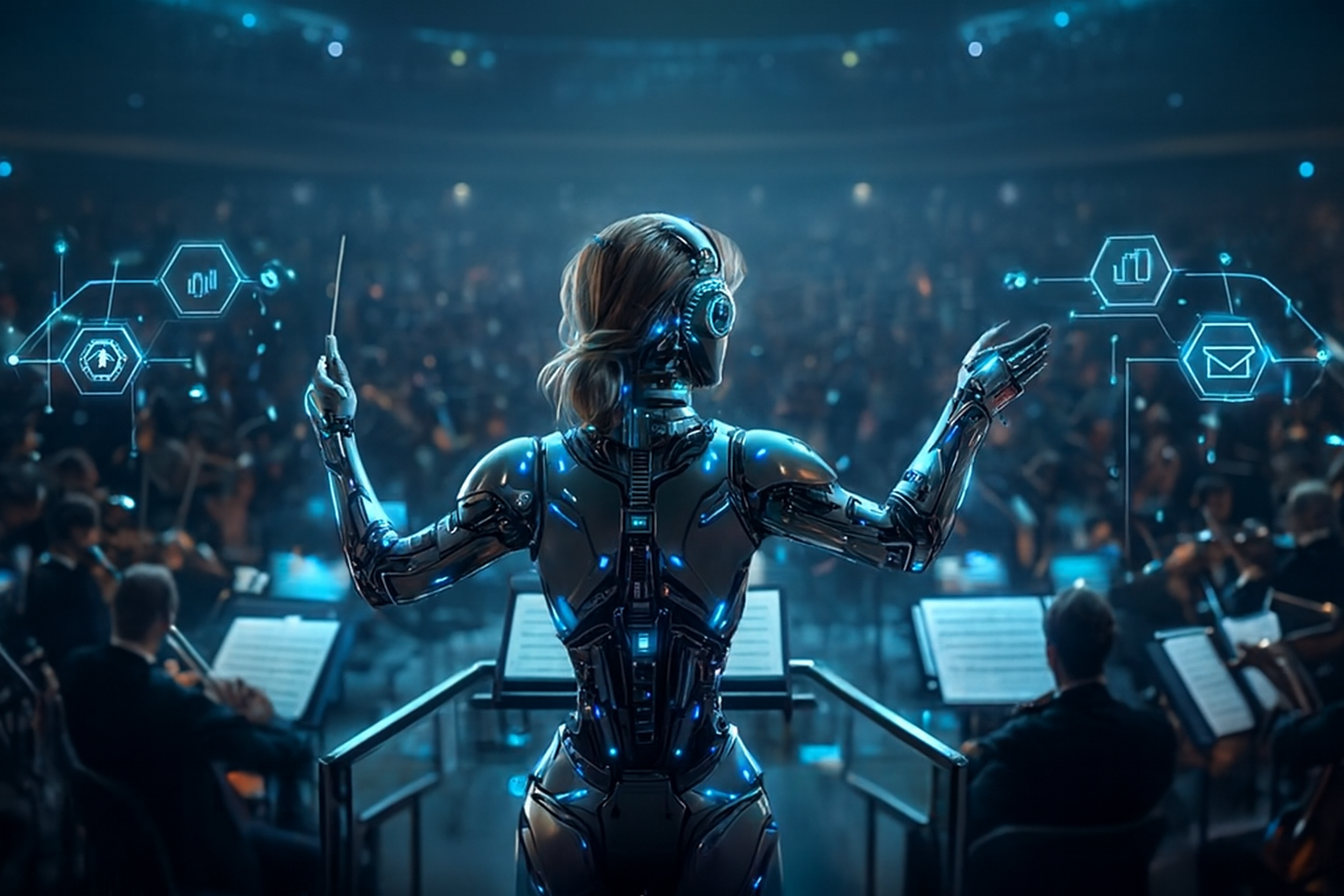
Marketing has become more powerful than ever.
It has also become harder for small businesses to understand.
Customers can discover a Houston business through Google, Maps, social media, reviews, directories, video, AI search, ChatGPT, Bing, or a recommendation somewhere else on the web.
Meanwhile, business owners are trying to manage websites, SEO, advertising, social media, analytics, content, reviews, email, and an expanding list of AI tools.
The problem isn’t that businesses need another marketing platform.
The problem is that all of these pieces produce information separately.
AI orchestration is emerging as a practical way to connect that fragmented marketing environment—helping businesses understand what is happening, recognize opportunities, coordinate execution, and make better decisions without adding more chaos.
That philosophy is central to how we built IMPROZ Marketing’s connected marketing system.
1. Why Small Business Marketing in Houston Feels More Complicated
Houston businesses have always operated in a competitive market.
What’s different today is how customers discover them.
Someone looking for a business may begin with Google, compare reviews in Maps, watch videos, search Instagram, read Reddit conversations, ask ChatGPT for recommendations, visit a website, and return later through another channel.
The customer journey is no longer a straight line.
Traditional SEO still matters, but search itself has expanded. Customers now discover brands across search engines, AI systems, social platforms, local listings, directories, reviews, and content.
That’s why IMPROZ approaches modern visibility through Search Everywhere Optimization.
But increased visibility creates another challenge.
Every channel generates signals:
- Website visits
- Search impressions
- Rankings
- Leads
- Advertising performance
- Social engagement
- Reviews
- Form submissions
- Local visibility
- Content performance
- AI referrals
- Customer behavior
The information exists.
The difficult part is understanding what all of it means together.
2. What Small Business Owners Actually Need
Most business owners aren’t asking for more software.
They’re asking much simpler questions.
Is my marketing working?
Where are customers finding me?
What should we improve next?
Are we spending money in the right places?
What opportunities are we missing?
What should my marketing team actually be doing?
Those questions sound simple.
Answering them becomes difficult when SEO data lives in one system, advertising in another, website analytics somewhere else, leads in a CRM, tasks in project management software, and customer behavior across several platforms.
This is where orchestration becomes valuable.
The goal isn’t to eliminate people from marketing.
It’s to help people see the whole picture more clearly.
3. What Is AI Orchestration in Marketing?
AI orchestration is the coordinated use of artificial intelligence, marketing data, workflows, and human expertise to help different parts of a marketing system work together.
The important word is orchestration.
Automation usually answers:
What task can we perform automatically?
Orchestration asks a broader question:
How do information, people, platforms, decisions, and execution work together?
For a small business, that might mean connecting information from:
- Website analytics
- Google Search Console
- Search visibility
- Paid advertising
- Social media
- Form submissions
- Customer interactions
- Reviews
- Local search
- Content
- AI discovery
Instead of evaluating every channel independently, orchestration helps create shared understanding.
That understanding can then guide better decisions.
4. Automation and Orchestration Are Not the Same Thing
Marketing automation is extremely useful.
A form can send an email.
A CRM can create a follow-up.
A scheduled workflow can publish content.
An advertising platform can automatically adjust bids.
Those are automations.
But automation alone doesn’t necessarily explain whether those actions support the larger business strategy.
A company can automate dozens of disconnected activities and still have disconnected marketing.
Orchestration operates at a higher level.
It helps connect:
Data → Signals → Understanding → Decisions → Execution
Automation may perform part of the execution.
People still determine what matters.
That distinction is important because IMPROZ does not believe AI should simply take control of a company’s marketing.
Technology should strengthen human judgment, not replace it.
5. What AI Orchestration Can Help a Small Business Do
When marketing information becomes easier to connect, business owners can spend less time trying to interpret fragmented dashboards and more time making decisions.
A connected system can help answer questions such as:
- Which marketing channels are contributing to real business activity?
- Where is visibility increasing or decreasing?
- Which content is beginning to perform?
- Are advertising costs changing?
- Are customers discovering the business in new places?
- Which website pages are creating engagement?
- Where are conversion opportunities being lost?
- What should the marketing team prioritize next?
This doesn’t mean AI magically knows everything.
It means the business has a better framework for turning fragmented information into actionable intelligence.
For smaller companies competing against organizations with larger teams, that kind of coordination can be especially valuable.
6. How IMPROZ Uses Axis to Connect Marketing Intelligence
IMPROZ experienced the same challenge our customers face.
Marketing data became increasingly fragmented.
Analytics told one story.
Search data told another.
Advertising platforms produced their own reports.
Websites generated behavioral signals.
Client work created tasks.
Past experience contained lessons that were difficult to consistently reconnect with future decisions.
So we built Axis.
Axis is IMPROZ Marketing’s proprietary marketing intelligence system.
It helps us connect marketing information so our team can better:
- Correlate fragmented data
- Identify meaningful signals
- Recognize opportunities
- Interpret marketing performance
- Create clearer reporting
- Coordinate recommended work
- Maintain accountability
- Recognize patterns over time
The important part isn’t the technology itself.
The important part is what the customer gets from it:
better understanding of what happened, why it matters, and what should happen next.
From Marketing Data to Coordinated Action
Our process increasingly follows a simple progression:
Evidence
What is actually happening?
↓
Signals
What changed or deserves attention?
↓
Understanding
What does the evidence mean in context?
↓
Recommendations
What opportunities or problems should be addressed?
↓
Execution
What work should happen next?
↓
Measurement
Did the work create meaningful progress?
That is much closer to how we think about AI orchestration today.
Not artificial intelligence running the business.
Connected intelligence helping people run the business better.
7. Search Everywhere Optimization Is Part of the Same System
Orchestration becomes even more important because customers no longer search in only one place.
Google remains enormously important.
But visibility also develops through:
- Google Maps
- Bing
- AI assistants
- AI search
- Social media
- Video
- Reviews
- Directories
- Brand mentions
- Community conversations
- Websites
This is the reason IMPROZ developed Search Everywhere Optimization.
Search Everywhere Optimization isn’t simply traditional SEO with a different name.
It is a response to how modern discovery actually works.
The objective is to strengthen a business’s visibility and authority across the places customers—and increasingly AI systems—use to understand brands.
Your website remains the digital foundation.
SEO remains important.
But they now operate inside a much larger discovery ecosystem.
8. Human Strategy Becomes More Important as AI Improves
There is an interesting contradiction happening in marketing.
As AI becomes more capable, good human judgment becomes more valuable—not less.
AI can summarize information.
It can identify patterns.
It can accelerate research.
It can help produce drafts.
It can assist with analysis.
It can support repetitive workflows.
But someone still has to decide:
- What does this business stand for?
- Who is the customer?
- What matters most?
- Is this recommendation appropriate?
- Does this message sound like the brand?
- Is this opportunity worth pursuing?
- Is this data actually meaningful?
- Should we act?
Those are strategic decisions.
That is why IMPROZ combines technology with experienced marketing professionals rather than presenting AI as a replacement for them.
The best model is not:
AI instead of people.
It is:
Better people equipped with better intelligence.
9. What Connected Marketing Looks Like for a Houston Business
Imagine a business discovers that:
Organic impressions are increasing, but clicks are falling.
At the same time, branded searches are increasing.
A particular service page is receiving more engagement.
Social posts about that service are performing better.
Form submissions from the website are increasing.
AI referral traffic begins appearing.
Traditional reporting might present those as separate metrics.
A connected marketing system asks a different question:
Are these signals related?
Maybe customers are discovering the brand earlier through search and AI, interacting with content somewhere else, and eventually converting through the website.
That changes how performance should be interpreted.
It may also change what the business should do next.
Perhaps the opportunity isn’t simply “get more traffic.”
It could be:
- Strengthen the service page
- Produce supporting content
- Improve schema
- Expand social visibility around the topic
- Strengthen reviews
- Improve conversion paths
- Create video content
- Increase local relevance
- Build supporting authority elsewhere on the web
That’s the difference between reading metrics and understanding a marketing system.
10. Where Should a Small Business Start?
You do not need to automate everything.
You do not need dozens of AI tools.
And you definitely don’t need to rebuild your entire marketing operation because someone told you AI changed everything.
Start with clarity.
Ask:
What are we trying to accomplish?
Then:
What information do we already have?
Then:
What is preventing us from understanding what’s happening?
Then:
Which part of the process would benefit most from better coordination?
For some businesses, the answer may be analytics.
For another, it may be website conversion.
For another, local visibility.
For another, content.
For another, advertising.
And sometimes the right recommendation is simply to fix the foundation before adding anything else.
That’s why IMPROZ approaches marketing as a connected system rather than a collection of services.
AI Orchestration Isn’t About Adding More Technology
Small businesses already have enough technology.
The real opportunity is making the information they already produce more useful.
AI orchestration can help connect marketing intelligence across channels, but technology alone isn’t the strategy.
The strategy comes from understanding:
what happened
why it happened
what it means
and
what should happen next
That creates clarity.
Clarity creates better decisions.
Better decisions create more coordinated execution.
And coordinated execution creates measurable progress.
That’s the kind of marketing system we’re building at IMPROZ.
How is AI orchestration different from marketing automation?
Marketing automation typically performs predefined tasks, such as sending emails, routing leads, or triggering workflows. Orchestration connects information and processes across a broader marketing system so people can make better decisions about what should happen next.
Can AI orchestration help small businesses compete with larger companies?
It can help smaller teams work with greater coordination and efficiency. By connecting fragmented marketing information and reducing unnecessary manual analysis, small businesses can make better use of the people, data, and resources they already have.
Does AI orchestration replace a marketing team?
No. IMPROZ uses AI to strengthen analysis, communication, coordination, and execution. Human judgment remains essential for strategy, creative decisions, brand direction, prioritization, and customer relationships.
How does Search Everywhere Optimization fit into AI orchestration?
Search Everywhere Optimization addresses how customers discover businesses across search engines, AI systems, maps, social media, reviews, video, directories, and other digital environments. Orchestration helps connect the intelligence generated across those environments so the business can better understand and coordinate its marketing.
What is Axis?
Axis is IMPROZ Marketing’s proprietary marketing intelligence system. It helps our team correlate fragmented marketing information, identify opportunities, improve reporting, coordinate recommended work, and recognize patterns that can help guide future decisions.
How do I know whether my business needs a more connected marketing system?
A good sign is when you have plenty of marketing activity but still struggle to answer basic questions about what’s working, why performance changed, or what your team should prioritize next. The goal isn’t to add technology simply because it exists. It’s to reduce uncertainty and improve decision-making.
Ready for More Clarity in Your Marketing?
You don’t need more marketing noise.
You need to understand what your marketing is telling you.
IMPROZ helps businesses connect website performance, search visibility, content, advertising, customer behavior, and marketing intelligence into a clearer picture of what is happening and what should happen next.
Explore Our Marketing System to see how IMPROZ connects intelligence, strategy, execution, and continuous improvement.
Or, if you’re ready to talk about your business: