
If your business website feels like a static brochure, you are missing out on valuable customer conversations. Modern web visitors do not want to just read a digital flyer; they expect a dynamic, two-way interaction that answers their questions in real time.
The challenge is that what defined an “interactive” website a few years ago is completely different today. To keep your audience engaged and outpace your competitors, your digital presence must adapt to modern user behaviors and web standards.
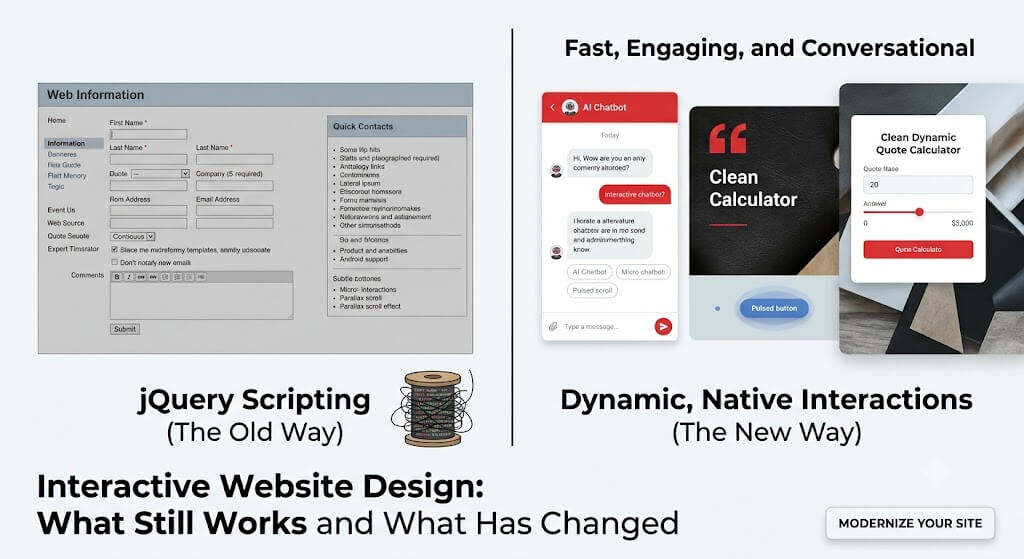
In the past, creating an interactive website required heavy, complex custom scripting. For years, developers relied heavily on libraries like jQuery to bridge the gap and add basic animations, fade-ins, or drop-down menus to standard HTML pages.
Today, web development has evolved. While those older scripts paved the way, modern interactive design relies on cleaner, faster, and more intuitive technology:
Then: Relying on bulky, third-party code libraries that could slow down your site’s load times.
Now: Utilizing native CSS animations, advanced JavaScript frameworks, and powerful design platforms like Elementor to build seamless interactions without sacrificing page speed.
Then: Static feedback forms and basic comment sections.
Now: Integrated AI chatbots, dynamic personalized content, interactive pricing calculators, and immersive visual storytelling.
Human beings are hardwired for communication. From the earliest days of storytelling, effective communication has always relied on a feedback loop—adjusting the message based on how the audience responds. Your website should do the exact same thing.
When you implement thoughtful interactive elements, you achieve three critical business goals:
Dwell Time: Visitors stay on your site longer, which signals value to search engines and boosts your organic visibility.
Trust Building: Interactive tools like instant self-assessments or guided paths help users find exactly what they need without friction.
Higher Conversions: True engagement turns passive readers into active leads.
True interactivity goes beyond flashing graphics or moving text. Today’s users expect functional interactivity that enhances their experience. Some of the most effective elements to consider include:
Dynamic Solutions: Tools like instant project quote builders or custom savings calculators.
Responsive Visuals: Micro-interactions, such as subtle button animations or scroll-triggered effects, that guide a user’s eyes to your primary call-to-action.
Conversational Interfaces: Live chat and smart messaging systems that act as a virtual representative standing inside your website to assist visitors 24/7.
At IMPROZ, we believe that web design should never be a guessing game. Beautiful code means nothing if it doesn’t create a seamless journey for your customers and turn traffic into revenue.
We build highly engaging, fast-loading platforms tailored to your business goals. Whether you need a complete overhaul or a strategic update to your current site, our team provides data-led website design support to ensure your brand stands out.
Are you ready to transform your digital presence into a customer-generating machine? Let’s build a strategy that works for you.
Explore our scalable Premier Website Package or our full-scale Elite Branded Website Package.
Ready for a tailored roadmap? Get a custom proposal today or connect with our team to discuss a comprehensive digital marketing strategy.