
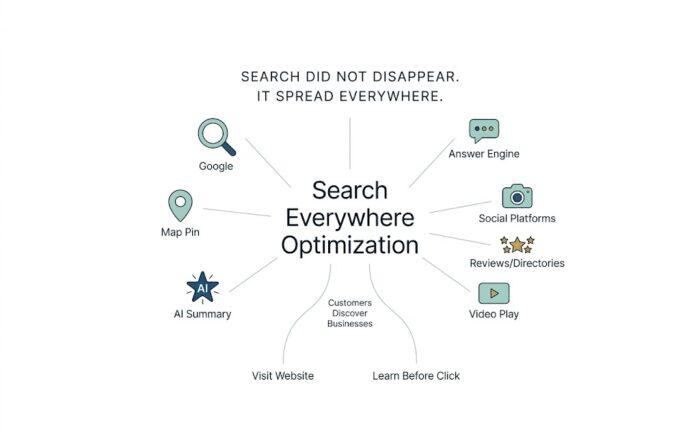
Search did not disappear.
It spread everywhere.
For years, search marketing followed a fairly predictable path: someone entered a query into Google, reviewed the results, clicked a website, and decided what to do next.
That path still exists. But it is no longer the only path—and increasingly, it is not the entire journey.
Customers now discover businesses through Google Search, Google Maps, AI-generated answers, ChatGPT and other answer engines, social platforms, reviews, directories, videos, communities, brand mentions, and recommendations.
Sometimes they visit the company website immediately.
Sometimes they learn enough about the company before they ever make that click.
That change is at the heart of Search Everywhere Optimization.
Search Everywhere Optimization is the IMPROZ philosophy for making a business understandable, discoverable, credible, and selectable across the places people—and increasingly AI systems—use to find answers.
The goal is no longer simply to rank.
The goal is to:
Be Found. Be Chosen. Be the Answer.
One of the more confusing changes in modern search is that visibility and website traffic are beginning to separate.
A business can gain impressions.
Its rankings can improve.
Its Google Business Profile can appear more often.
Its content can be crawled, indexed, and understood.
And yet website clicks may not increase at the same rate.
That does not mean clicks no longer matter.
They do.
Qualified traffic matters.
Leads matter.
Sales conversations matter.
Revenue matters.
What has changed is something more fundamental:
A click is no longer the only evidence that visibility occurred.
A customer may discover your business in Google Maps, encounter your name in an AI-generated answer, see a LinkedIn post, read a review, search the company later by name, visit the website, and finally contact you.
Traditional attribution may credit only the final interaction.
The customer experienced an entire visibility journey.
Modern SEO has to account for that larger journey.
Traditional SEO was built largely around a ranking economy.
The model looked something like this:
Search → Ranking → Click → Website → Conversion
That model still matters.
But modern discovery increasingly looks more like:
Question → Answer → Brand Exposure → Verification → Selection
That changes the strategic question.
It is no longer enough to ask:
How do we rank for this keyword?
We also have to ask:
How do we become one of the trusted answers to this question?
That is a larger problem.
And it requires a larger strategy.
Search Everywhere Optimization is IMPROZ’s response to the way discovery is changing.
It is the practice of making a business understandable, discoverable, credible, and selectable across the search engines, maps, AI systems, platforms, and sources customers use while making decisions.
Depending on the business, that can include:
But Search Everywhere does not mean creating an account on every platform and publishing everywhere indiscriminately.
Being everywhere poorly is not Search Everywhere Optimization.
Being present where your market actually makes decisions is.
A search engine can crawl your website.
An AI system can understand your pages.
Google can index your content.
Your business can appear in Maps.
Those things help you become findable.
They do not automatically make you selectable.
There is another progression happening:
Found → Understood → Trusted → Chosen
That progression depends on more than one webpage.
A business becomes easier to trust when the same core facts appear consistently across multiple credible sources.
Its services are clear.
Its location is clear.
Its expertise is demonstrated.
Its reviews support the story.
Its case studies provide proof.
Its social profiles reinforce the same identity.
Its citations are consistent.
Other websites mention it.
Customers talk about it.
Its content repeatedly demonstrates knowledge around the same subject areas.
Your website tells search systems who you are.
The rest of the web helps them determine whether that story is credible.
Keywords still matter.
They reveal language, intent, demand, competition, and opportunity.
But people do not think exclusively in keywords.
They have questions.
Who should I hire?
Which company is best for this problem?
Who serves my area?
What should this cost?
What is the difference between these services?
How long should this take?
Can I trust this provider?
How do I know whether this is actually working?
Answer engines are fundamentally built around questions.
That changes how we think about websites.
Every important page should know the question it owns.
The IMPROZ homepage should answer:
Why should I choose IMPROZ?
The Search Everywhere Optimization page should answer:
How can my business be found across Google, Maps, AI search, and the other places customers look for answers?
The local SEO page should answer:
How do I improve my visibility in Google Maps and local search?
The website design section should answer:
What kind of website will actually help my business grow?
The paid media section should answer:
When should I pay to accelerate demand instead of waiting for organic visibility to develop?
And our marketing case studies should answer:
Can IMPROZ demonstrate how its approach works in real businesses?
That gives us a simple content standard:
Answer quickly. Prove the answer. Help the buyer reach the next question.
This is different from simply adding an FAQ accordion to every page.
The entire page should be built around answering a meaningful buyer question.
A strong modern service page needs several layers.
The visitor should understand the core answer quickly.
Do not bury the value behind three paragraphs of introduction.
If someone asks what Search Everywhere Optimization is, answer it.
If they ask how local SEO works, answer it.
If they ask what separates one Houston digital marketing agency from another, give them useful criteria.
Once the first question is answered, the next questions naturally follow.
How does it work?
How long does it take?
What does it cost?
What should I expect?
How do I know it is working?
What happens if I do nothing?
Those questions should help shape the page.
Claims need evidence.
That evidence can include:
client case studies, reviews, project examples, performance data, screenshots, methodology, experience, documented outcomes, and third-party validation.
Humans and machines should both be able to understand:
Who provides this service?
What exactly do they provide?
Who is it for?
Where do they operate?
How does the service relate to the rest of the business?
Once the visitor has an answer, what should they do next?
Read a case study?
Explore a related service?
Request a consultation?
Compare options?
Contact the company?
The page should lead somewhere intentionally.
There is a limit to what a company can prove by talking about itself.
Any agency can put this on its homepage:
“We are one of the best digital marketing companies in Houston.”
That is a claim.
It becomes more credible when the broader web supports it.
Search and AI systems can encounter corroborating evidence through:
Google Business Profile.
Reviews.
Local directories.
Professional directories.
Industry mentions.
Partner websites.
Community organizations.
News and PR.
Case studies.
Social profiles.
Relevant backlinks.
Customer discussions.
The business does not need every source on the internet to repeat identical language.
But the overall entity story should be coherent.
If your website says one thing, your Google Business Profile says another, directories contain an old address, and third-party sources barely mention your services, the system has to reconcile uncertainty.
When the evidence agrees, the business becomes easier to understand.
And easier to trust.
That is why local citations, digital PR, brand mentions, reviews, and authority building still matter in the AI era.
AI search did not eliminate geography.
If anything, local intent makes geographic evidence even more important.
A customer asking:
“What is SEO?”
is asking a different question from:
“Who does SEO near me?”
One requires information.
The other requires a business recommendation.
Google Maps, proximity, reviews, service-area relevance, Google Business Profile information, local citations, geographic signals, and local authority all contribute to that picture.
For IMPROZ, that means maintaining our broader identity as a Houston digital marketing agency while building legitimate relevance around Northeast Houston communities such as Kingwood, Humble, Atascocita, and the Lake Houston area.
The strategy is not to manufacture dozens of thin location pages.
It is to make legitimate geographic relationships clear.
Where do you operate?
Where are your customers?
Where have you performed work?
Where are customers reviewing you?
Where do third-party sources associate your company?
Build evidence around the market you actually serve.
Small businesses do not have unlimited time, money, or content-production capacity.
Neither do small agencies.
So the answer cannot simply be:
Post everywhere.
Search Everywhere is about strategic distribution.
We should prioritize channels according to questions like:
Where do customers actually research businesses like this?
Where are competitors establishing authority?
Which sources influence search and AI understanding?
Where can the company maintain a credible presence?
Which content can be reused intelligently?
Where is the strongest relationship to commercial demand?
For IMPROZ today, that includes our website, Google Search, Google Business Profile, LinkedIn, Facebook, citations, case studies, and emerging AI visibility.
Other channels can be added when the opportunity justifies the effort.
That may include YouTube, Reddit and community visibility, digital PR, third-party publications, partnerships, or other discovery surfaces.
Search Everywhere is not about chasing platforms.
It is about following the customer.
Modern marketing creates an enormous amount of information.
Search Console provides search signals.
Google Business Profile provides local signals.
Analytics provides behavior signals.
Paid advertising provides another set of signals.
Rank tracking adds another.
AI visibility creates another.
Reviews.
Content.
Case studies.
Technical SEO.
Website performance.
Conversion behavior.
Competitor activity.
The problem is not a shortage of data.
The problem is deciding what the data means.
That is why IMPROZ built Axis.
We did not build Axis simply because artificial intelligence became popular.
We built it because modern marketing became too interconnected to operate intelligently through disconnected dashboards, isolated tactics, and fragmented decisions.
Raw data is not strategy.
Axis exists to help connect the system.
Search Everywhere is the strategy.
Axis is the system IMPROZ built to operate it.
Axis helps us look across marketing disciplines instead of treating every channel as a separate universe.
Search, local visibility, content, technical health, conversion, paid media, website performance, reputation, and business objectives affect one another.
Axis helps us analyze those relationships.
Not every ranking movement deserves action.
Not every SEO warning matters equally.
Not every impression represents buyer demand.
Not every form submission is a qualified lead.
Not every traffic decline means SEO failed.
Context matters.
Modern SEO is not only acquisition.
It is also visibility defense.
Technical failures, broken redirects, indexing problems, stale content, schema errors, Google Business Profile disruptions, tracking failures, migrations, security problems, and competitive changes can all damage visibility a business has already earned.
Preventing those losses is valuable.
Marketing has no shortage of things that could be done.
The harder question is:
What should we do next?
Axis helps us prioritize actions according to evidence, opportunity, risk, and business value.
Traffic is not the final objective.
Neither are rankings.
Neither are AI mentions.
The objective is qualified demand and business growth.
The visibility system has to remain connected to that outcome.
We are not observing the changing search environment from the sidelines.
IMPROZ operates inside it.
We watch our own rankings.
Our own impressions.
Our own click-through rates.
Our own Google Maps visibility.
Our own AI visibility.
Our own content.
Our own citations.
Our own case studies.
Our own technical infrastructure.
Our own conversion quality.
Our own successes.
And our own failures.
Those observations influence how Axis develops and how our strategy evolves.
That makes IMPROZ Client Zero.
We use our own company to experience many of the same changes our clients face.
That matters because modern search is changing too quickly for strategy to remain theoretical.
We need observation.
We need evidence.
And we need systems capable of learning from what actually happens.
The answer is not to stop measuring traditional SEO.
Rankings still matter.
Clicks still matter.
Conversions still matter.
Revenue absolutely matters.
But the measurement model needs to become larger.
Traditional performance can include:
Modern visibility may also include:
The purpose is not to replace one set of vanity metrics with another.
An AI citation that never contributes to commercial value is not automatically success.
A million impressions that never create qualified demand are not success either.
The objective is to understand how visibility contributes to business growth when the customer journey is no longer a clean:
keyword → click → form submission
Modern marketing requires interpretation.
Every major shift in search seems to produce another declaration that SEO is dead.
It is not.
Technical SEO still matters.
Content still matters.
Links still matter.
Local SEO still matters.
Search intent still matters.
Website quality still matters.
Those foundations remain important because search engines and AI systems still need good information to work with.
What changed is the environment around them.
SEO now operates alongside Maps, AI-generated answers, social discovery, reputation, entity understanding, third-party corroboration, and increasingly complex buyer journeys.
Modern AI SEO is not the abandonment of SEO.
It is the expansion of SEO into a broader visibility discipline.
At IMPROZ, we call that:
Search Everywhere Optimization.
Search is no longer one place.
Visibility is no longer one metric.
And the customer journey no longer begins and ends with a Google click.
People are asking questions across search engines, Maps, AI systems, social platforms, reviews, directories, communities, and other sources.
The businesses that remain easy to understand, easy to verify, and easy to trust across those environments have the greatest opportunity to be selected when the customer is ready to choose.
That is Search Everywhere Optimization.
Be Found. Be Chosen. Be the Answer.
Explore Search Everywhere Optimization to see how IMPROZ approaches visibility across traditional search, local discovery, AI search, and the broader customer journey.
Or learn more about Axis, the IMPROZ marketing system, and how we connect the signals behind modern marketing decisions.