
Choosing the right digital infrastructure determines how effectively your business engages customers, captures data, and scales operations online. While the terms “website” and “web application” are often used interchangeably, they serve entirely different business functions. Understanding this distinction ensures you invest in the right technology for your goals rather than overpaying for unneeded features or outgrowing a platform too quickly.
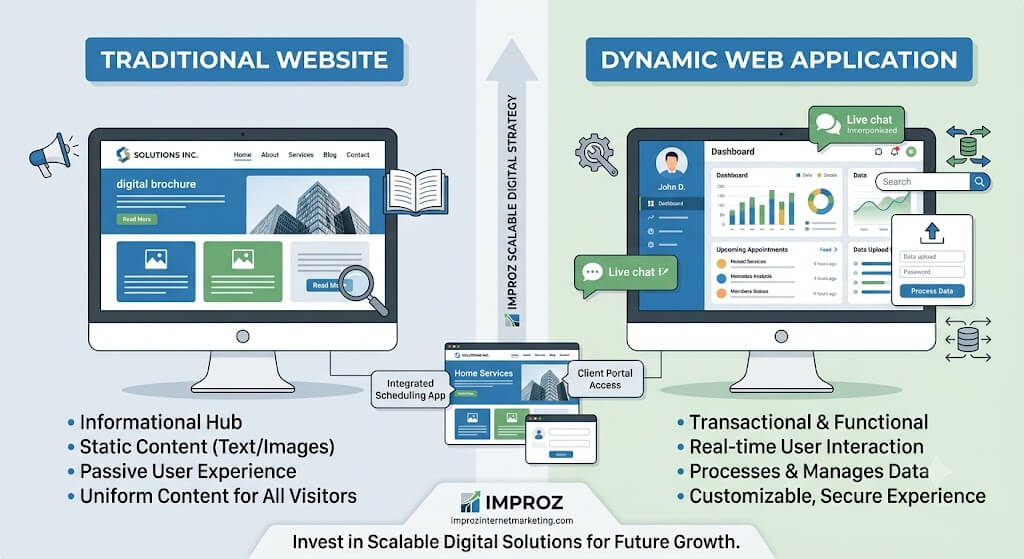
A traditional website primary serves to deliver information. It acts as a digital brochure or virtual storefront, providing visitors with static content such as text, images, and videos.
Classic examples include informational blogs, corporate portfolios, or news sites like Wikipedia and CNN. On these platforms, the user experience is primarily passive—you read, look at graphics, or watch a video, but the underlying content remains identical for every visitor.
A web application is a highly interactive platform designed for user transactions, data processing, and customizable experiences. Instead of just displaying information, a web app performs specific business functions based on direct user input.
Platforms like Google Docs, eBay, Facebook, and custom customer portals are web applications. They require user authentication, securely manage and process databases, and alter their display or output dynamically for each individual user.
The line between websites and web applications has shifted significantly over the years.
The Old Way: Websites were strictly digital billboards—completely static HTML pages where any minor content update required a developer. Web applications were heavy, complex systems reserved only for massive tech giants or e-commerce companies.
The New Way: Today, modern platforms blur these lines. Even standard business websites leverage modular web app functionalities—such as live chat, interactive calculators, dynamic scheduling tools, and localized content delivery. Modern user expectations demand that web presences do more than just exist; they must actively solve problems in real-time.
Regardless of whether your business needs a streamlined informational site or a robust application, several core digital marketing fundamentals remain unchanged:
Clear Value Proposition: Visitors must instantly understand who you are and how you can help them within seconds of landing on your page.
Mobile Responsiveness: Your platform must adapt seamlessly across all devices, ensuring an optimal viewing and interactive experience.
Fast Loading Speeds: Page performance directly influences user retention and search engine rankings.
When launching or updating your online presence, you don’t have to choose between a rigid billboard or an overly complex application. A successful digital ecosystem builds with future scalability in mind.
At IMPROZ, we design highly optimized corporate websites that can seamlessly scale to incorporate custom applications—whether that means integrating client portals, custom booking engines, or interactive databases later on.
If you want to evaluate your current platform or map out a scalable digital strategy, explore our tailored website packages or request a custom digital marketing strategy to see how we can expand your business capabilities.