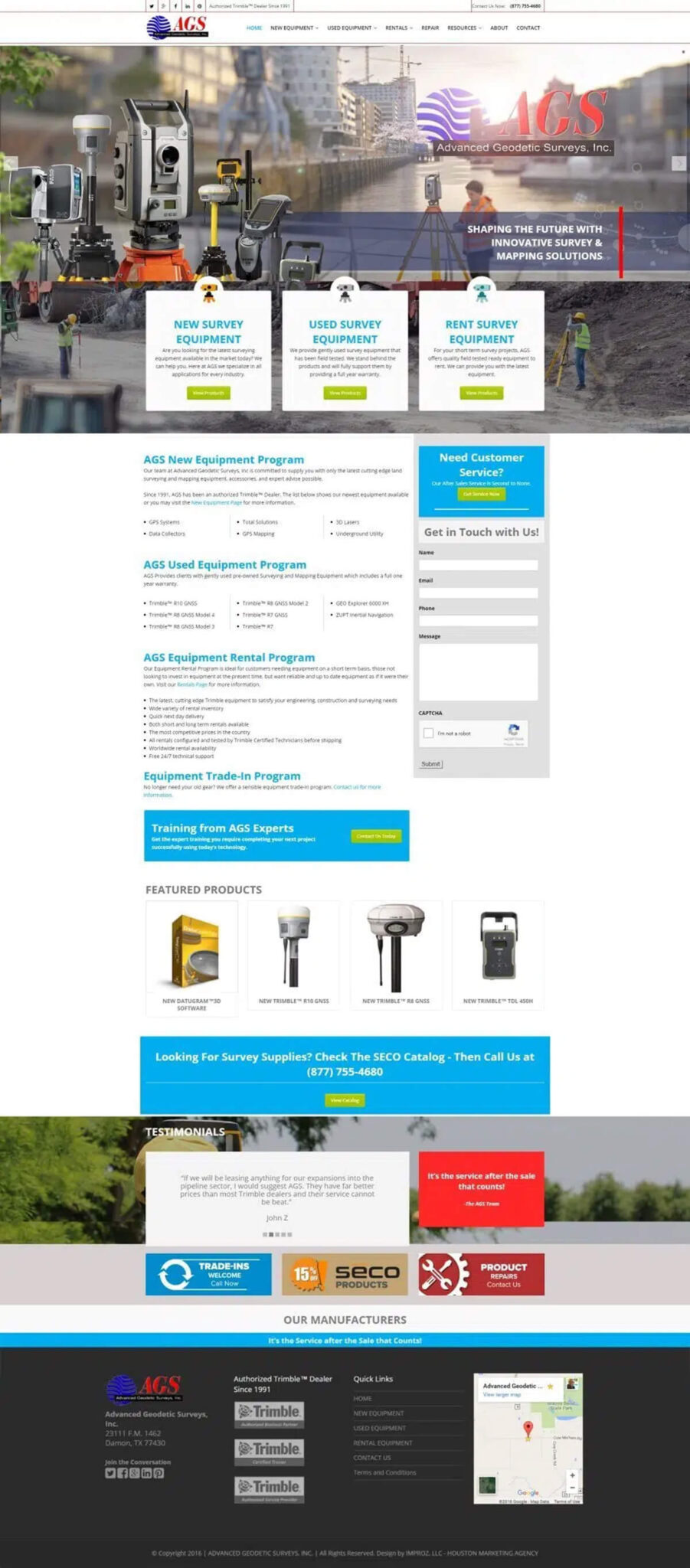
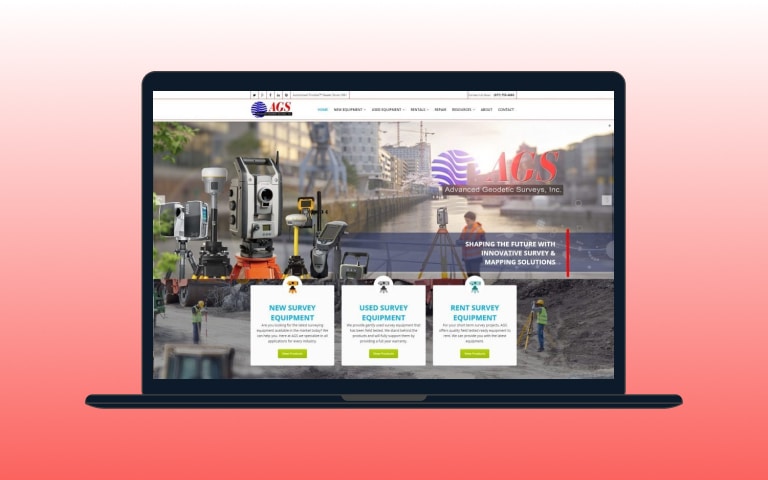
Advanced Geodetic Surveys was an established surveying business operating in a technical industry with a lot to explain.
Its challenge was not simply getting a website online.
The company had multiple services, a large range of products, and several different ways customers could do business with it. Some buyers needed new survey equipment. Others were looking for used equipment. Others only needed to rent equipment for a project.
Behind each of those choices were deeper product categories, different questions, different inquiry needs, and different customer journeys.
The marketing challenge was therefore bigger than design.
IMPROZ needed to organize a complex business into a website that felt simple to use, gave its many products enough room to be presented properly, supported the forms and lead paths behind those choices, and created useful destinations for SEO and Google Ads.
We also supported Advanced Geodetic Surveys through ongoing SEO, social media, and paid search.
Taken together, the project reinforced an important principle:
A complex business does not need a complicated customer experience. It needs the right architecture.
Built a substantial website for an established land surveying and survey-equipment company
Organized a complex product offering into clear customer pathways
Simplified the first decision into new, used, or rental survey equipment
Created deeper internal pages to present the products within those categories
Built form pathways around the different types of customer intent
Created more specific landing destinations for SEO and Google Ads traffic
Supported the website with ongoing search optimization
Managed Google Ads around active search demand
Supported social media as another layer of ongoing visibility
Created the type of connected website and marketing system IMPROZ now delivers through a Premier Website Program paired with a Growth Visibility Plan
Industry: Land Surveying / Geodetic Surveying / Survey Equipment
Services Demonstrated: Website Design, Website Strategy, Information Architecture, Product Organization, Form Strategy, SEO, Social Media Marketing, Google Ads, Ongoing Digital Visibility
Goal: Organize a complex surveying and equipment business into a website that customers could navigate easily while creating a stronger platform for organic search, paid media, and ongoing marketing.
Closest Current Website Equivalent: Premier Website Program
Closest Current Ongoing Marketing Equivalent: Growth Visibility Plan
Advanced Geodetic Surveys predates IMPROZ’s current package and plan structure.
Based on the depth of the website, the number of pages involved, the complexity of the product organization, and the continuing combination of SEO, social media, and Google Ads, the engagement most closely resembles a Premier Website Program supported by a Growth Visibility Plan today.
The website provided the structure.
The ongoing marketing gave that structure reach.
The Business Was Complex — The Website Could Not Feel That Way
When people inside a business work with its products and services every day, the structure can feel obvious.
To a customer, it often is not.
Advanced Geodetic Surveys operated in a specialized industry with multiple services and a large range of surveying equipment.
The company needed to present products that could be purchased new, purchased used, or rented.
That sounds simple until the depth behind those categories is considered.
Each category contained many products.
Each product needed to be presented in a way that helped buyers understand what was available.
Different customers had different needs.
And the inquiry process needed to support those differences.
The website had to carry all of that complexity without making the customer feel as though they had to understand the entire AGS business before they could take the next step.
That became one of the central strategic problems of the project.
The business could be complex. The customer journey could not be.
Advanced Geodetic Surveys needed a larger website.
But page count by itself was not the strategy.
The business had enough services, products, and customer pathways that compressing everything into a small website would have created a worse experience.
Product information would have competed for attention.
Different services would have been harder to understand.
Search engines would have had less context.
Paid campaigns would have had fewer useful destinations.
And potential customers would have been forced to dig through general information to find what mattered to them.
The additional pages were valuable because they gave the business enough digital structure to explain itself properly.
One of the clearest examples was the equipment side of the business.
A visitor could be looking for:
New Survey Equipment
Used Survey Equipment
or
Rent Survey Equipment
Those three choices became a simple first layer of navigation.
But that was only the beginning.
Once the customer selected a path, they still needed to move into the relevant products within that category.
The website therefore had to work in layers.
First, simplify the decision.
Then reveal the depth.
That allowed AGS to present a large product offering without overwhelming the customer with the full catalog all at once.
The website architecture could not stop at the page.
Once a customer chose new, used, or rental equipment, the inquiry process needed to continue that logic.
A person interested in purchasing equipment might need to provide different information than someone looking to rent it.
A rental inquiry could involve different project needs.
A product inquiry could require different follow-up.
That meant the forms needed to support the customer journey rather than act as a generic contact box.
The objective was to carry intent through the entire path:
what the customer wants → what they view → what they inquire about → what AGS receives
That made the website more useful to the customer and more useful to the business receiving the lead.
Search optimization needs content and structure to work with.
A business can offer many products and services internally, but search engines only understand what is actually represented clearly on the site.
The deeper AGS website created more opportunities to build relevance around different services, equipment categories, and specific customer needs.
That gave the SEO program a much stronger foundation than a small general-purpose website could have provided.
Paid search brought another requirement.
Someone searching specifically for survey equipment rental should not have to land on a generic homepage and then figure out where the rental options are.
Someone interested in used survey equipment should not be routed through an unrelated path.
The architecture needed to support alignment between the search, the advertisement, and the landing destination.
That meant creating a more direct path:
specific search intent → relevant ad → matching page → appropriate inquiry
instead of:
specific search intent → generic homepage → customer searches the site
That distinction seems small.
Strategically, it is significant.
The strategy was to build the website as the central digital platform and organize the business around the way customers actually needed to use it.
The new, used, and rental equipment structure gave customers an immediate way to orient themselves.
Instead of confronting a long product inventory at the beginning, the visitor could first answer a much easier question:
How do I want to acquire the equipment?
That decision narrowed the journey.
From there, the visitor could move into the relevant products within that path.
The website did not remove the complexity of the business.
It organized it.
Each major equipment path needed its own internal structure.
AGS carried many products within those categories, so the customer journey had to continue beyond the first click.
That meant creating deeper internal pages where products could be presented in a more organized way.
The architecture became layered:
New / Used / Rent → relevant products → product information → inquiry
This is an important distinction in strategic website design.
The customer does not need to see everything at once.
They need to see the right thing next.
The inquiry system followed the same principle.
Different paths deserved different context.
Rather than treating every lead as an identical “contact us” submission, the site could organize the inquiry around what the visitor was actually interested in.
That helped preserve intent all the way through the lead process.
The forms were therefore part of the website strategy.
Not an afterthought.
Good website architecture does not end at navigation. It carries customer intent into the conversion system.
The deeper site structure also created a stronger organic search foundation.
Every meaningful service, category, and product-related page added context.
That allowed SEO efforts to be more specific.
Instead of asking one page to rank for everything AGS offered, the site could create clearer relationships between search intent and relevant content.
That gave search engines more information about the business and gave searchers more relevant entry points.
The same structure improved paid-media relevance.
A campaign built around rental demand could point toward rental content.
A used-equipment search could be directed toward used products.
A more specific product need could be connected to a more relevant part of the site. The goal was not merely to generate clicks. It was to improve what happened after the click.
The website helped create continuity between:
the keyword → the advertisement → the page → the form
That made the website a functioning part of the paid-media system rather than simply the place traffic was sent.
This is where the project most closely resembles today’s Premier Website Program.
Premier is not simply a larger website package.
It is appropriate when the business requires more strategic organization, more content depth, more customer pathways, and more digital surface to support marketing.
Advanced Geodetic Surveys needed that depth.
Not because bigger was better.
Because the business itself required more architecture.
The value of the website came from simplifying what was complex.
Advanced Geodetic Surveys had many products.
It had different equipment acquisition options.
It had multiple service areas.
It had different types of prospective customers.
And it was marketing through multiple channels.
The website gave those moving parts structure.
New, used, and rental equipment became clear first-level choices.
The product pages behind them provided the necessary depth.
The forms supported those different pathways.
SEO had more specific content to optimize.
Google Ads had better places to send traffic.
Social media could point people back into a more complete digital environment.
The larger website did not make the customer journey more complicated.
It made the business easier to understand.
That is the key lesson:
Premier-level strategy is not about adding pages. It is about knowing when a complex business needs more pages so the customer experience can become simpler.
Advanced Geodetic Surveys needed more than a digital brochure.
It needed an information system.
The website had to organize services, product categories, individual products, customer choices, and inquiry pathways.
That became the foundation for everything that followed.
Once the business had been organized into relevant pages, those pages created opportunities for organic discovery.
Different search needs could connect to different areas of the site.
Specific services could have clearer relevance.
Equipment categories could be represented more accurately.
The website gave SEO something meaningful to build upon.
Paid search created another route into the system.
When someone was actively looking for a service, product, or equipment option, Google Ads allowed AGS to compete for that demand.
The stronger site architecture meant the campaign did not have to stop at a generic destination.
Traffic could be directed deeper into the customer journey.
Social media provided another place for the business to remain visible.
Not every customer converts from the first search.
People may encounter the company several times before taking action.
Search, advertising, social media, and the website could reinforce one another across those interactions.
This is what makes the project a strong historical example of what IMPROZ now calls Growth Visibility.
Growth Visibility is not about operating channels independently.
The website, SEO, paid advertising, and social presence should support the same business strategy.
For Advanced Geodetic Surveys:
The website organized the business.
SEO helped people discover it.
Google Ads captured active demand.
Social media extended visibility.
Forms turned specific customer intent into more useful inquiries.
That is a connected marketing system.
Advanced Geodetic Surveys illustrates why some businesses need more than a foundation-level website.
A Premier-type project may be appropriate when the business has:
AGS had many of those characteristics.
Its website needed enough depth to make the rest of the marketing more effective.
EXPLORE THE PREMIER WEBSITE PROGRAM
The project did not end when the website was built.
IMPROZ also supported Advanced Geodetic Surveys through SEO, social media, and Google Ads.
That continued work mattered because a strong website and ongoing visibility solve different problems.
The website answers:
What happens when someone gets here?
The ongoing marketing answers:
How do more of the right people get here?
That is the relationship between Premier and Growth Visibility.
Premier builds the system people arrive at.
Growth Visibility helps create the opportunities for them to arrive.
AGS demonstrated both.
Advanced Geodetic Surveys is an older IMPROZ engagement, and the original website is no longer active.
We are therefore not reconstructing historical rankings, traffic totals, advertising conversion rates, lead volumes, or revenue attribution that we cannot verify today.
What we can support is the scope and architecture of the work.
IMPROZ:
The evidence in this case is not a reconstructed performance percentage.
It is the structure of the marketing system and the work required to make a complex business easier for customers to navigate.
The more complex a company becomes internally, the more tempting it can be to reproduce that complexity online.
That is usually the wrong goal.
Customers do not need to understand the company’s internal structure.
They need to know what to do next.
Advanced Geodetic Surveys had a large number of products and multiple ways customers could acquire them.
The website reduced that first decision to something understandable:
New. Used. Rent.
Then it allowed the appropriate depth to appear when the customer needed it.
The same logic continued through the product pages, the forms, SEO, and advertising.
That is what strategic website architecture is supposed to do.
Do not make the customer learn the business. Organize the business around the customer’s decision.
Your company may have many services.
A large product catalog.
Different types of customers.
Multiple sales paths.
Organic search opportunities.
Google Ads campaigns.
Social media activity.
And a lot of information that needs to be communicated accurately.
The answer is not necessarily to make the website smaller.
The answer is to organize the complexity.
Advanced Geodetic Surveys needed enough website depth to represent the business, enough structure to simplify the customer journey, and enough marketing support to create visibility around it.
That is the kind of relationship IMPROZ now delivers through a Premier Website Program paired with a Growth Visibility Plan.