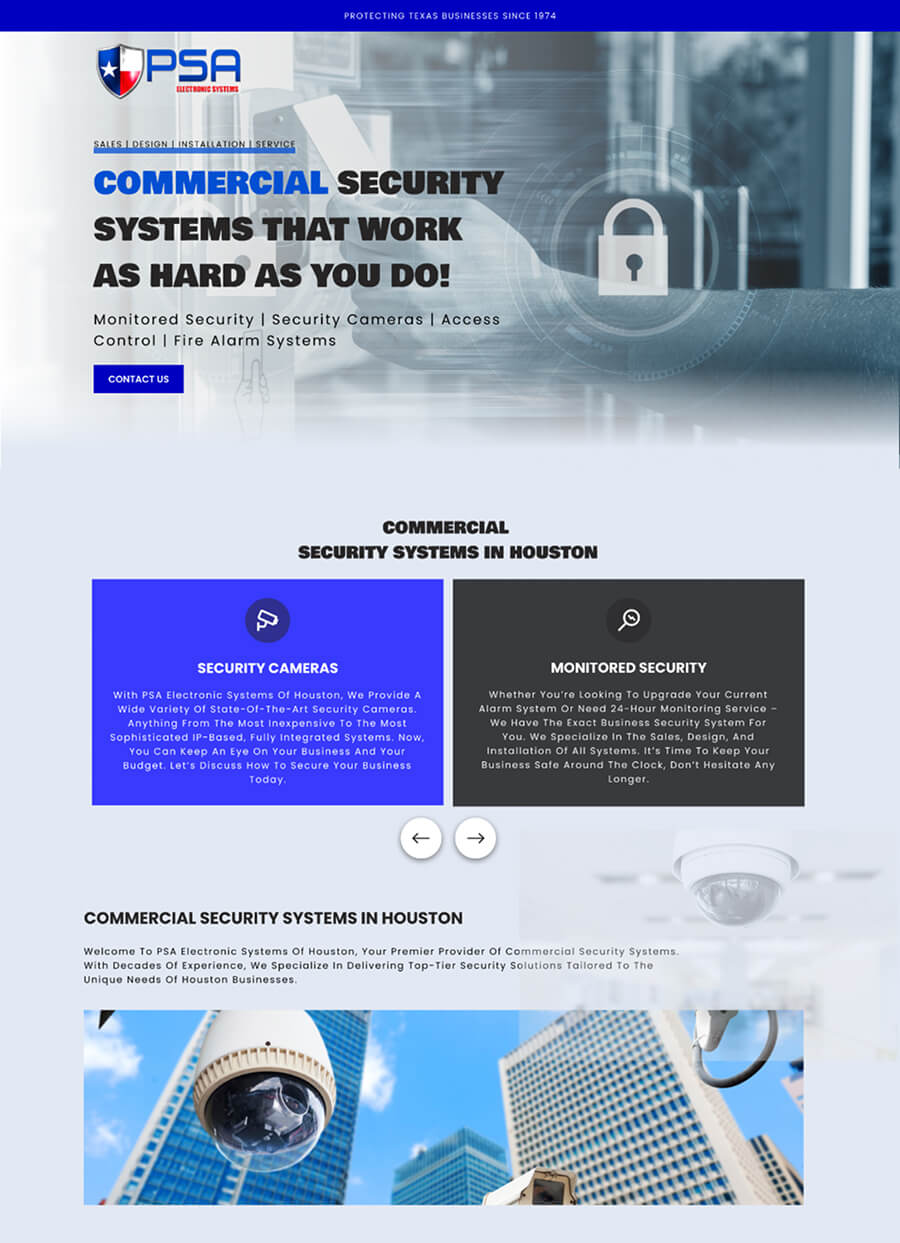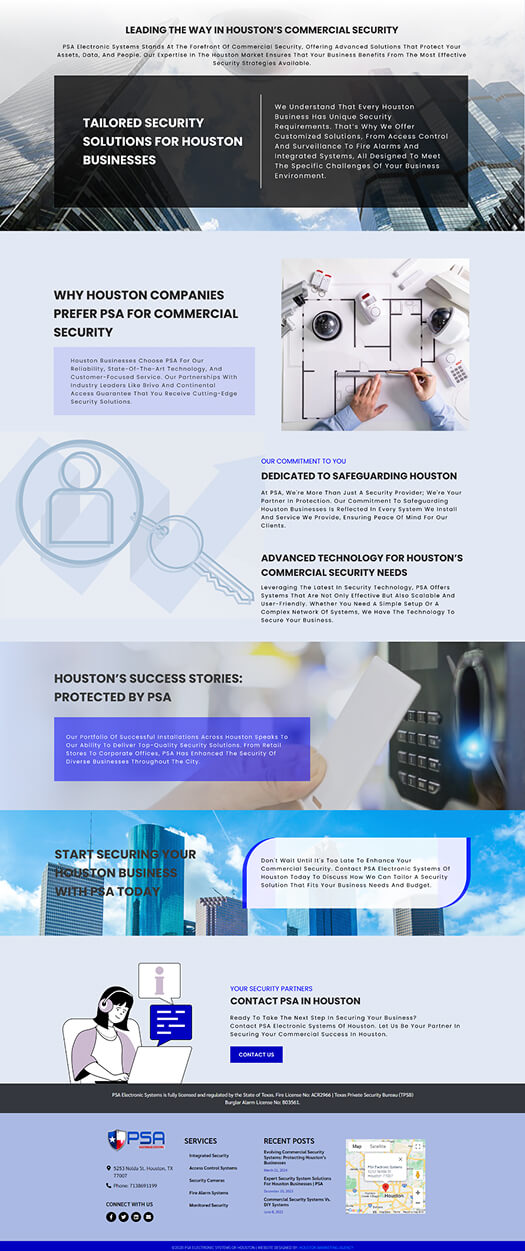
PSA Electronic Systems of Houston needed to reach more business customers as a long-standing relationship with a major grocery store chain weakened. The company wanted to broaden its customer base without losing its commercial-security focus.
The challenge was not simply getting more people to search for security systems.
It was making sure the marketing reached businesses—not homeowners.
This commercial security systems marketing case study centers on that distinction. IMPROZ’s SEO and Google Ads work needed to communicate the intended customer clearly, attract relevant searches, and limit residential demand that did not fit the business.
The central lesson was straightforward:
More visibility is only valuable when it creates opportunities with the customers the company actually serves.
Focused SEO and Google Ads on commercial security customers rather than a general security audience.
Aligned advertising language and website content with business-security needs.
Used negative keywords to limit irrelevant residential searches.
The original case reported a broader customer mix, better-qualified leads, and less wasted advertising spend.
Industry: Commercial Security Systems
Primary Services Demonstrated: SEO, Google Ads, Keyword Strategy, Advertising Copy, Negative Keyword Targeting, Commercial-Focused Website Content
Goal: Help PSA reach additional business-security customers while limiting irrelevant residential inquiries.
The focus of this engagement was search marketing.
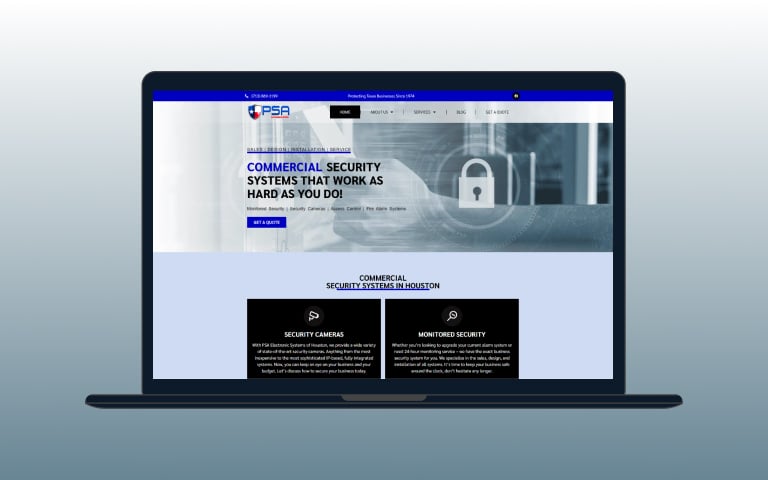
The website supported that work as the destination where prospective customers could understand PSA’s business-security offering. The main strategic challenge was deciding which searches to pursue and how to communicate the commercial focus consistently.
Reaching more customers and reaching more types of customers are not necessarily the same objective.
PSA needed additional opportunities within its intended market. A residential inquiry would not become a good fit simply because it arrived through a successful advertisement or an organic search result.
That made audience definition essential.
The marketing needed to expand PSA’s reach while remaining specific about whom the company served.
A general phrase such as “security systems” leaves an important question unanswered:
Security systems for whom?
Compare that with “business security systems” or “commercial security systems.” Those phrases establish the intended setting more clearly.
For PSA, that distinction was not a minor copy preference. It was the central targeting problem.
The advertising and SEO needed to articulate the business-security offer rather than leave prospective customers to infer it. Commercial relevance had to be part of the message, not a qualification introduced after someone made contact.
A campaign can generate activity without solving the right business problem.
An impression shows that an advertisement appeared. A click shows that someone was interested enough to visit. Neither, by itself, establishes whether that person needs the service the company intends to provide.
For this engagement, the useful question was therefore not only:
“How do we attract more attention?”
It was:
“How do we attract attention from businesses that need commercial security systems?”
That question shaped both the paid-search strategy and the organic content direction.
The strategy centered on making the intended customer clear throughout the search experience.
SEO and Google Ads served the same business objective, but they required different methods. Paid search combined relevant targeting with exclusions. SEO depended on content that accurately explained PSA’s commercial-security focus.
Keyword selection needed to reflect customer fit, not simply a connection to the word “security.”
The distinction between general security interest and a business-security need gave the strategy its direction.
A useful way to understand that distinction is to compare the meanings of “security systems” and “business security systems.” The second phrase provides additional context about who needs the service.
The objective was not to pursue every related search. It was to identify the searches that made sense for PSA’s commercial offering.
Relevance to the industry was the starting point. Relevance to the customer was the deciding factor.
The advertising language needed to carry the same commercial focus as the targeting.
An ad should not invite a broad audience and rely on the website to explain later that the service is intended for businesses. For PSA, the message needed to make the business-security context clear before the inquiry.
That meant articulating the offer around the customers PSA wanted to reach rather than relying on general security language.
The purpose was not merely to make the advertisement sound appealing. It was to help the appropriate prospect recognize that the offer matched their need.
IMPROZ used negative keywords as part of the Google Ads strategy to limit irrelevant residential queries.
Negative keywords provide an exclusion mechanism for paid search. They help advertisers restrict searches they do not want their campaigns to target, although their effectiveness depends on the terms and matching rules used. They are not a guarantee that every unsuitable inquiry will disappear.
For PSA, the principle was to protect the campaign’s commercial focus.
Choosing what not to pursue was part of choosing the right audience.
The SEO work focused website content on business-security terminology and the needs of prospective commercial customers.
SEO for security companies requires clarity about the company’s actual specialty. Broad security language alone does not explain whether the content concerns residential systems, commercial systems, or another category entirely.
Google’s guidance emphasizes anticipating the language readers use and creating clear, useful content—not mechanically repeating every keyword variation. Google for Developers
For PSA, the objective was to explain the commercial offering naturally and consistently so that the content supported the same audience the advertising was intended to reach.
The strategic value was in the alignment.
It would make little sense to target business-security searches with an advertisement that sounded residential. It would be equally inconsistent to write a commercially focused ad and send the visitor to content that left the intended customer unclear.
Each part of the marketing needed to support the same understanding:
PSA was pursuing business-security customers.
The positive targeting defined the opportunity. The advertising expressed the offer. The exclusions helped narrow paid-search exposure. The SEO content reinforced the commercial context.
These were not separate attempts to generate more traffic.
They were complementary ways of addressing the same problem: making the company visible to the right audience without treating every security-related search as equally valuable.
The larger lesson is that specificity does not have to weaken a growth strategy.
A company can pursue a broader customer base while becoming more precise about the customers it wants to serve.
Organic visibility needed to support the business PSA intended to grow.
The role of SEO in this case was to connect the company’s content with commercial-security needs, rather than create a general security information destination.
The strategic question remained the same across the content: would this help a business customer understand the offer?
Paid search was another route toward that commercial audience.
The campaign objective was not separate from the SEO objective. Both needed to attract people whose needs matched the company’s services.
That shared customer definition gave the two channels a consistent direction, even though their execution differed.
Negative keywords complemented the searches the campaign was designed to pursue.
Their role was not to create demand. It was to help keep unsuitable searches outside the paid targeting.
This illustrates why exclusion decisions belong within campaign strategy rather than being treated as an incidental cleanup task. Google explicitly identifies choosing what not to target as part of building a focused campaign. Google Help
The website’s role was to support the expectation established through search.
Once a prospective customer arrived, the content needed to continue explaining the business-security offer rather than introduce a different message.
In this case, the website supported the acquisition strategy. The central achievement was not its size or page count, but its role within a commercially focused search-marketing approach.
The original project account reports that PSA attracted a wider mix of small-business customers, received more qualified leads, and reduced irrelevant traffic and wasted advertising spend. These are qualitative historical outcomes.
This case does not present reconstructed traffic totals, conversion percentages, advertising returns, or revenue attribution.
It also does not present today’s keyword research as the original campaign keyword list.
The documented approach—and the experience this case demonstrates—is the deliberate use of SEO, Google Ads, commercial messaging, and paid-search exclusions to pursue a more appropriate audience.
The lesson does not depend on manufacturing a performance percentage.
It depends on understanding why the customer distinction mattered and how the marketing was organized around it.
“Security company marketing” is a broad description of the work.
For PSA, the meaningful question was more specific:
How should a commercial security systems company use search marketing to reach businesses rather than residential customers?
That question changed the standard for a useful keyword, an effective advertisement, and relevant website content.
The objective was not to make PSA appear relevant to everyone interested in security.
It was to make the company’s relevance clearer to the customers it wanted.
Good targeting does not simply bring more people to a business. It helps bring the right business opportunities.
Your company may have a clear specialty while its marketing communicates something much broader.
You may serve commercial customers while receiving residential inquiries. Your advertising may generate clicks without making the intended audience clear. Your website may describe what you do without explaining whom it is for.
The answer is not necessarily more traffic.
It may be a more deliberate relationship between your positioning, SEO, Google Ads, and website content.
PSA’s case illustrates why those decisions need to work together.
IMPROZ helps businesses connect search visibility with the customers and opportunities they actually want to pursue.