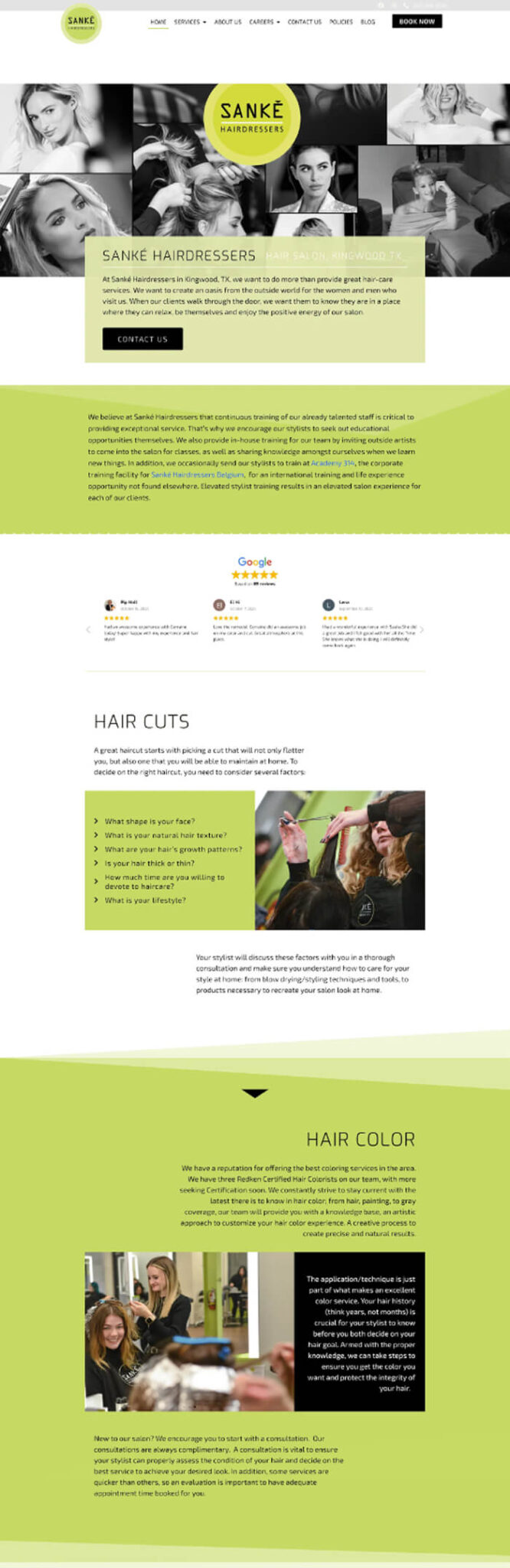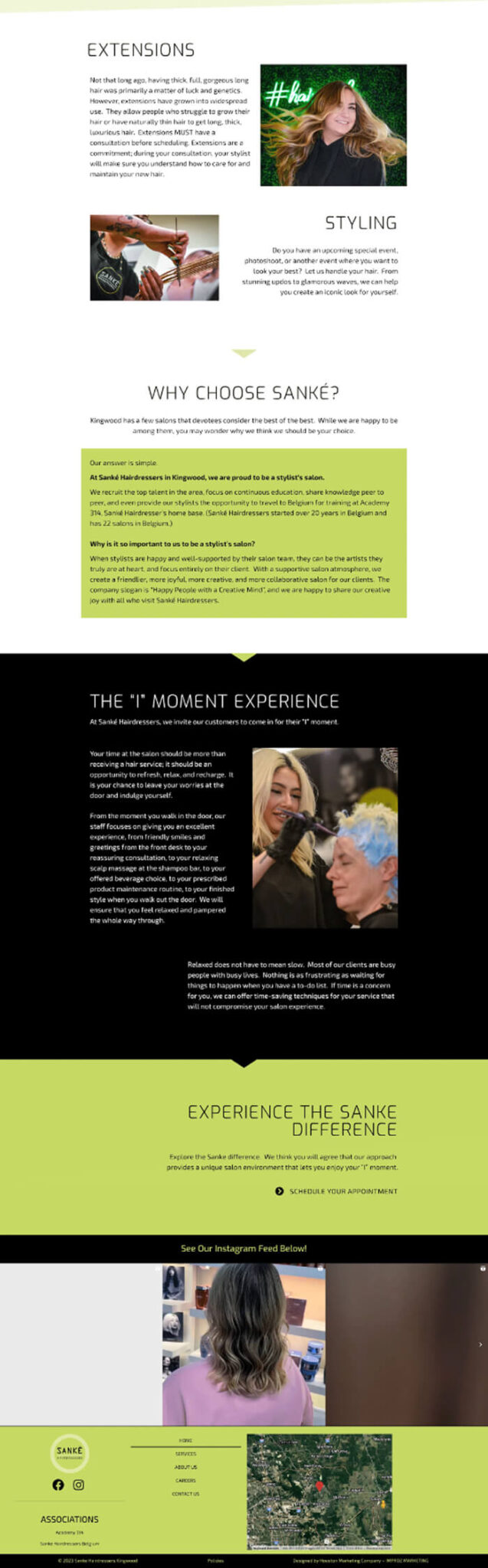
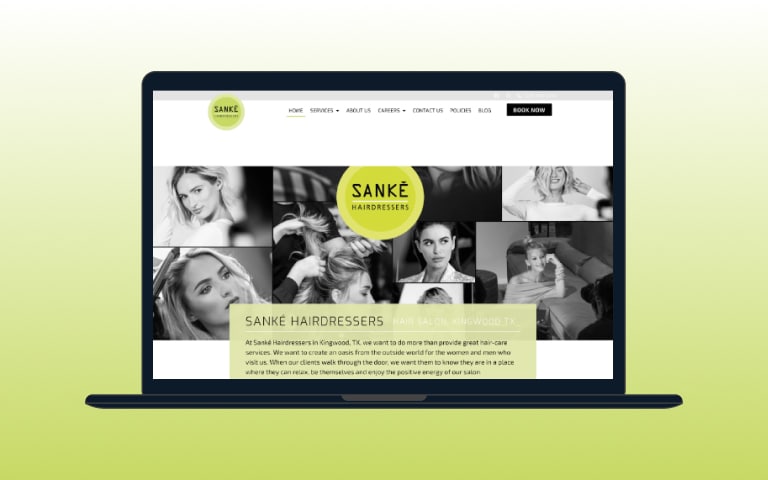
Sanke Hairdressers already had something many businesses struggle to create: personality.
The salon had energy, character, and a recognizable presence in Kingwood. Our job was not simply to put its services online. The website needed to feel like Sanke while giving the business a stronger foundation for local search and digital marketing.
The project also reinforced an important lesson for IMPROZ: experience in an industry does not mean every business in that industry should receive the same strategy. We had worked with salons before. What we still had to learn was Sanke’s market.
Built a website designed to reflect Sanke’s personality and energy rather than relying on a generic salon template
Created a clearer digital foundation for the salon’s services and local presence
Applied prior salon marketing experience without assuming the same strategy would transfer unchanged
Identified Kingwood’s strong local-market identity as an important factor in search and customer behavior
Reinforced an IMPROZ operating principle: industry experience should expand the toolbox, not become a cookie-cutter solution
Developed a strategy around the specific business, brand, audience, and geography rather than the industry alone
Industry: Hair Salon / Beauty
Services Provided: Website Design, Local SEO, Search Strategy
Goal: Build a digital presence that reflected Sanke’s distinctive brand while creating a stronger foundation for reaching and attracting customers in the Kingwood market.
Salon websites can become remarkably similar.
Large photographs. Service menus. Stylist profiles. Appointment buttons.
Those elements may all be necessary, but they do not automatically communicate why someone would choose one salon over another.
Sanke had its own personality.
The business carried an energy that customers could experience in the salon itself, and the website needed to translate that feeling into a digital environment.
A technically functional site would not have been enough.
The design needed to represent the brand.
IMPROZ had already worked with salons in Houston and Atascocita.
That experience gave us useful context. We understood many of the services, customer questions, competitive pressures, and search behaviors common within the salon industry.
But Sanke exposed an assumption worth challenging.
Knowing salons did not mean we automatically knew this salon’s market.
Sanke is in Kingwood, and Kingwood has a strong local identity.
Residents often prefer to shop, hire, dine, and do business within Kingwood when they can. That sense of community can affect how businesses are discovered, evaluated, trusted, and ultimately chosen.
The geography was not simply another city name to place into SEO copy.
It was part of the marketing environment.
A salon in Houston, a salon in Atascocita, and a salon in Kingwood may offer many of the same services.
That does not mean their markets behave the same way.
The competitive landscape changes.
Customer expectations change.
Local identity changes.
Search behavior changes.
The businesses customers consider genuinely local can change.
Even the importance of proximity and community recognition can change.
That meant our previous salon work could inform the strategy, but it could not dictate it.
The strategy was to combine what we already understood about salon marketing with a fresh understanding of Sanke itself and the Kingwood market.
We did not want previous experience to become a template.
We wanted it to become a starting point.
The first priority was to make sure the website represented Sanke.
That meant designing around the personality of the business rather than beginning with a standard salon layout and trying to make the brand fit inside it.
The website needed to communicate energy without sacrificing usability.
Visitors still needed to understand the salon, its services, and how to take the next step.
Brand expression and clarity had to work together.
Local SEO is not simply the process of adding a geographic modifier to a page.
A location affects who the real competitors are, how customers define “local,” what businesses they trust, and which search signals matter. For Sanke, understanding Kingwood became part of understanding the customer.
That required thinking beyond:
“How do we market a hair salon?”
and instead asking:
“How do we market this hair salon to this community?”
That distinction changed the way we thought about the project.
Our prior salon experience still mattered.
It gave us a better understanding of salon services, customer journeys, common search behavior, and the ways people evaluate beauty businesses.
But it did not give us permission to assume the answer.
We used the experience to recognize patterns faster while remaining willing to discard the patterns that did not fit.
That is a very different use of expertise than simply repeating the last successful campaign.
Once we understood the brand and the Kingwood market, the website still had to help people make a decision.
That meant organizing the experience around the questions prospective salon clients were likely to ask.
What services are offered?
Does this salon fit my style and expectations?
Is it convenient for me?
Why should I trust this business?
How do I take the next step?
The website needed to make those answers easy to find while giving search engines clearer signals about Sanke’s services and local relevance.
That is where brand strategy, user experience, and SEO came together.
The site could not just look like Sanke.
It also had to make Sanke easier to understand, find, and choose.
A website often becomes one of the first meaningful interactions a potential customer has with a business.
For a salon, visual presentation matters.
But good design is not simply decoration.
It helps customers form an expectation about the experience they are considering buying.
When the website feels disconnected from the actual business, that expectation becomes weaker.
When the brand carries naturally from the salon into the website, the digital experience becomes part of the larger customer experience.
There is a common belief that the safest marketing agency is one that works almost exclusively within your industry.
Industry specialization can absolutely have advantages.
It may shorten the learning curve and give an agency familiarity with common services, terminology, competitors, and customer concerns.
But specialization can also create a blind spot.
Repeatedly solving the same kind of problem can eventually turn experience into a template.
Working across industries exposes IMPROZ to different:
Those lessons can transfer.
A trust problem solved for a professional service company may influence how we structure credibility for another business.
A conversion lesson from one industry may improve the customer journey in another.
A local-search challenge in one community may help us recognize why a different geography needs a completely different approach.
Experience becomes more valuable when it gives you more ways to solve a problem, not fewer.
The strongest evidence from the Sanke project is strategic rather than a manufactured ranking or traffic claim.
We can directly support that:
What this case does not require is an exaggerated claim that one design or SEO decision alone caused a specific business result.
The more durable lesson is what the project taught us about how marketing experience should be used.
One of the most common questions business owners ask a marketing agency is:
“Have you worked in my industry before?”
It is a reasonable question.
But it should not be the only one.
A better set of questions might be:
Can the agency understand my business?
Can they understand my customers?
Can they understand my market?
Can they recognize what makes my brand different?
Can they identify which lessons from previous experience apply — and which ones do not?
Can they adapt when the market contradicts their assumptions?
Sanke reinforced that distinction for IMPROZ.
Our salon experience helped.
Our willingness to learn Sanke and Kingwood mattered just as much.
The right question was never simply:
“What works for hair salons?”
It was:
“What will work for this salon, with this brand, serving this market?”
Your industry matters.
So does your market, your brand, your customers, your competitive environment, and the way people actually choose businesses like yours.
At IMPROZ, experience is not a reason to give every client the same answer.
It is a larger toolbox for finding the right one.