Tricia Kuehnert’s professional reputation was central to her business. Kuehnert Appraisal & Consulting needed a brand and website that reflected her experience, personal presence, and class while helping prospective clients understand exactly what she did.
Her specialty was personal property: artwork, antiques, furniture, and other possessions—not real estate. That distinction mattered, but the broad description “property appraiser” did not fully explain her expertise or the different circumstances that brought people to her.
IMPROZ connected personal branding, custom photography, website strategy, and search-focused marketing to make that expertise more accessible. The objective was not to invent a new identity for Tricia. It was to express the identity she had already established and help the right customers recognize its value.
Preserved the connection between the Kuehnert name and Tricia’s established professional identity.
Created original brand photography through a staged shoot in her home.
Developed a distinctive website presentation around the business owner rather than a generic appraisal-company template.
Organized services around the reasons customers needed an appraisal.
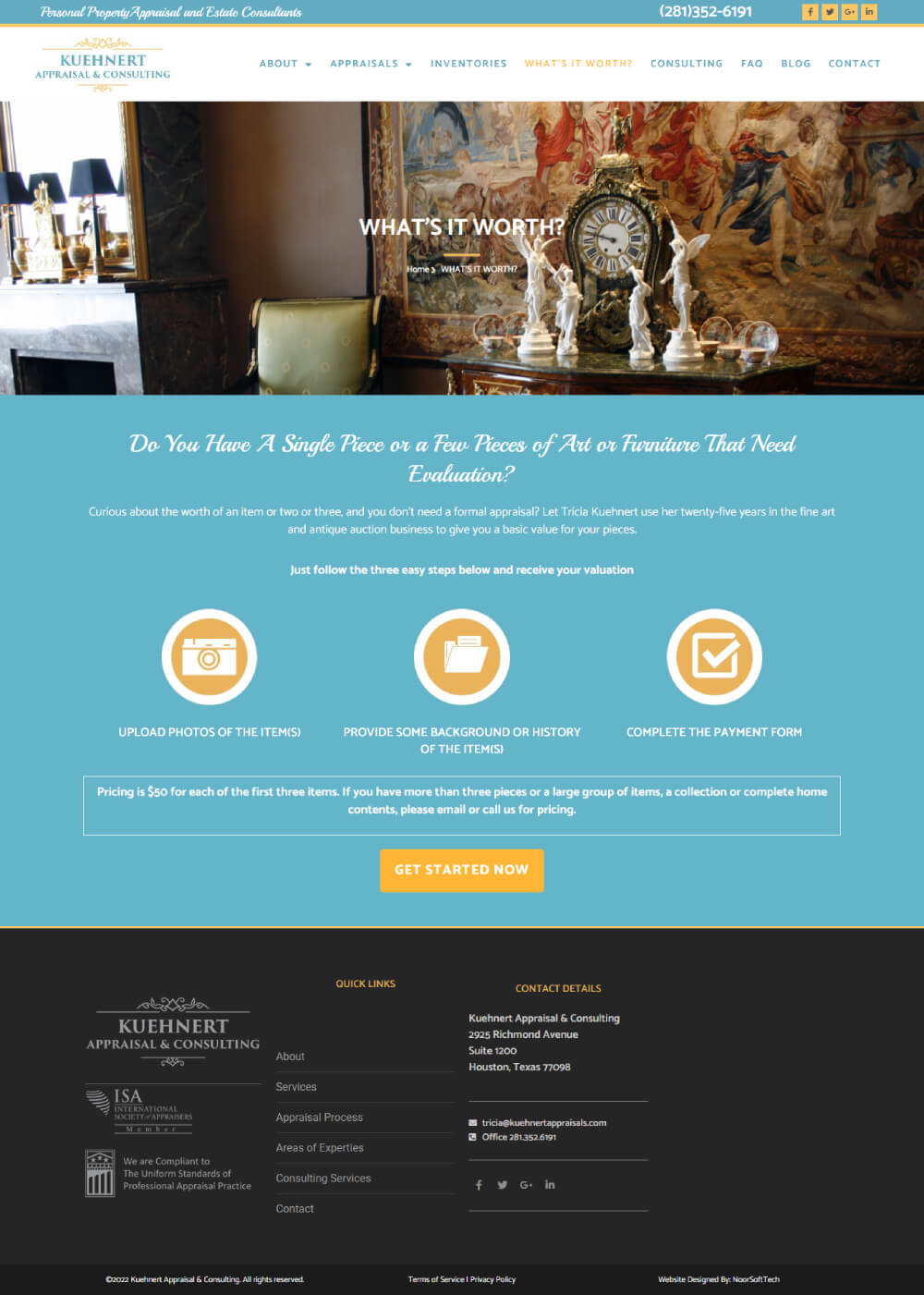
Created “What’s It Worth?” as a dedicated pathway for individual-item valuation requests.
Reviewed website inquiries included requests involving individual artwork and estate contents with antiques—needs consistent with her specialty.
Industry: Personal Property Appraisal and Estate Consulting
Services Provided: Brand Development, Custom Photography, Website Strategy and Design, Service Organization, SEO, Advertising, and Inquiry-Form Development
Goal: Express Tricia’s established professional identity, distinguish her specialty from real-estate appraisal, and connect prospective clients with the appropriate services.
Kuehnert was one of IMPROZ’s early Branded Elite projects.
Its defining characteristic was not simply a polished appearance. The work connected the owner’s identity with original photography, customer-focused service organization, search intent, and practical website functionality.
The brand influenced how the website should feel. The customer’s needs influenced how it should work.
For Kuehnert, the business name and the person behind it were closely connected.
Tricia had an established professional history, and retaining the Kuehnert name helped preserve that continuity. The website needed to carry that recognition forward rather than make the business feel disconnected from the person clients knew.
Her class was equally important to the presentation.
A generic appraisal website would not communicate what made her distinctive. But an artificially luxurious design would miss the point, too. The goal was not to borrow sophistication from a template.
The brand needed to reflect the refinement and personal credibility already present in its owner.
The word “property” created a practical marketing challenge.
Someone looking for a property appraiser could need a valuation of a house or land. Tricia’s work concerned the possessions themselves.
That meant a search could sound relevant while representing the wrong need.
The website and marketing had to make the distinction clear without burying the offer in professional terminology. Prospective clients needed to recognize that the business could help them understand the value of personal belongings, collections, or estate contents.
The issue was not whether someone owned a home.
It was whether they needed the value of the home—or the value of the items inside it.
Tricia understood her profession. But knowing how to perform the work and organizing that work for a prospective customer are different challenges.
Her clients could approach with very different circumstances. The business addressed estate matters, insurance needs, divorce, charitable donations, and other reasons for obtaining a personal-property appraisal.
A broad “appraisal services” description would not necessarily help someone recognize where their situation belonged.
IMPROZ needed to help translate an experienced professional’s knowledge into a structure that made sense to people outside the profession.
The expertise existed. The website needed to give customers a way into it.
Tricia also brought a specific idea to the project: create a way for someone with an individual possession to request help understanding its value.
That was a different situation from arranging a larger appraisal engagement.
A person asking about one piece of artwork or furniture needed an appropriate starting point. Sending every visitor through the same general inquiry process would leave that distinction unexplained.
The challenge was to give Tricia’s idea a clear service definition and a practical online experience without confusing an individual-item valuation with a formal appraisal.
We began with the relationship between the person, the expertise, and the customer.
The website needed to communicate who Tricia was, explain what she appraised, organize the reasons someone might need her, and provide an appropriate next step. Each decision had to support that same experience.
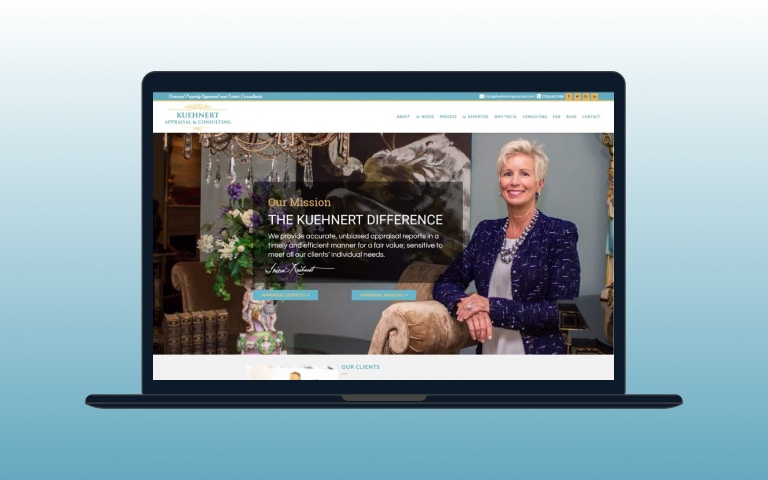
IMPROZ staged a photography session in Tricia’s home and created the portrait used in the website presentation.
That setting mattered. It connected the brand to the actual person and the kinds of surroundings associated with her work, rather than relying on interchangeable stock imagery.
The photograph became part of a broader visual expression built around her established professional name and personal style. The refined presentation was intended to feel recognizably hers.
This is what made the branding work deeper than decoration.
We were not trying to make an ordinary template look expensive. We were developing a presentation that expressed the person whose judgment prospective clients would be trusting.
The identity came from Tricia. Our role was to translate it into a cohesive digital presence.
The service language and search-marketing direction needed to distinguish personal-property appraisal from real estate.
That required more than placing “appraiser” throughout the website. The content needed to explain the objects being valued and the situations in which Tricia could help.
We focused the communication on her actual specialty, giving prospective clients a clearer understanding of the business before they made contact.
The same distinction guided the SEO and advertising work: relevance meant reaching people with an appropriate appraisal need, not simply attracting anyone searching for a property valuation.
The objective was not broader attention at any cost. It was a clearer connection between the searcher’s need and Tricia’s expertise.
IMPROZ worked with Tricia to develop a menu that organized her services from the customer’s perspective.
The needs-based navigation separated estate appraisal, divorce, charitable donation, liquidation, insurance coverage, damage claims and inspections, and bankruptcy appraisals.
These categories gave a broad professional capability a more understandable structure.
Instead of requiring visitors to interpret the full meaning of “property appraiser,” the website allowed them to begin with the situation they already understood.
This also gave the content a more specific purpose. Each service could be explained in relation to why someone needed it, rather than presenting every appraisal as the same engagement.
We did not invent new expertise for Tricia. We helped organize the expertise she already had around the people who needed it.
Tricia challenged us to create a way for people to request valuations of individual items. We helped turn that idea into the “What’s It Worth?” website experience.
The page established a specific offer for one to three items and distinguished a basic valuation from a formal appraisal. It explained a process involving item photographs, background or history, and a payment form, with larger collections directed toward a separate conversation.
That gave a particular customer need its own route into the business.
The page was not simply another description of Tricia’s services. It connected a familiar question—“What is this worth?”—with a defined way to request her help.
Her idea became something a customer could understand and act on.
The website addressed several different uncertainties without treating them as unrelated problems.
A prospective client needed to understand the person behind the business. The personal brand and photography helped communicate that presence.
The visitor also needed to know whether Tricia handled the right kind of property. Clear service language established the specialty.
Once that distinction was understood, the needs-based navigation helped connect the visitor’s circumstances with the appropriate service. The inquiry pathways then provided a practical next step.
The value was in how those decisions reinforced one another.
An elegant website alone would not resolve an unclear service offering. A detailed service menu alone would not express the personal identity behind the business. A contact form alone would not explain which type of help someone should request.
The website did not ask customers to understand the appraisal profession first. It helped them understand how Tricia’s expertise related to their own situation.
That is the broader lesson of the project: a brand becomes more useful when its identity, language, structure, and functionality tell the same story.
The Kuehnert name, original photography, and refined presentation connected the website to the business owner.
That connection was intentional. The project was built around a professional whose reputation and personal presence mattered to the offer.
Rather than separating the company from its owner, the brand made that relationship part of the experience. The website became a place where Tricia’s identity could be expressed consistently alongside her services.
The distinction between personal property and real estate shaped what relevant visibility meant.
A visitor seeking a house valuation was not the same opportunity as someone needing help with inherited antiques or an individual artwork.
The marketing needed to preserve that difference. Search terminology and website content were therefore part of the business positioning—not simply technical additions made after the design was complete.
The aim was to help the appropriate audience recognize the service.
The menu provided more than navigation.
It translated a broad professional identity into recognizable reasons to engage the business. A visitor could start with a need rather than having to decide which professional description applied.
This connected the website’s structure to the way the services were explained. The organization helped make a specialized business more understandable without reducing the depth of the expertise behind it.
he website offered different starting points for different needs.
“What’s It Worth?” addressed individual items, while the broader appraisal process and contact options supported other requests. The homepage made those routes visible rather than treating every visitor as though they needed the same engagement.
That distinction connected the presentation of the business with its practical use.
The website did not stop at explaining who Tricia was. It helped people determine how to approach her for assistance.
The project’s evidence includes the original photography, the branded website presentation documented in IMPROZ’s portfolio, the needs-based service navigation, and the dedicated individual-item valuation experience.
Those elements show the work in concrete form: an owner-led identity translated into imagery, a broad specialty organized into understandable services, and a client idea developed into a practical website feature.
Contact messages reviewed for this case also included relevant personal-property inquiries. One concerned the valuation of an individual artwork. Another requested an appraisal of an estate’s personal property containing antiques.
These are examples of the kinds of needs the website was designed to address. They are not presented as a count of completed engagements or a measure of revenue.
Together, the implemented website and the reviewed inquiries demonstrate a meaningful connection between the strategy and the way prospective clients used the site.
Kuehnert gained more than a polished presentation. The business gained a clearer way to express Tricia’s identity, explain her expertise, and receive requests for appropriate help.
You may already have years of experience, a strong professional reputation, and a distinctive way of serving your clients.
Your website should make those qualities easier to recognize—not replace them with a presentation that could belong to anyone.
It should also help people understand what you do, determine whether your expertise matches their situation, and take the appropriate next step.
For Kuehnert Appraisal & Consulting, that meant connecting Tricia’s personal brand with a clearly defined specialty, customer-focused service organization, and practical inquiry pathways.
IMPROZ brings those decisions together through brand development, original creative work, website strategy, and search-focused marketing.
The goal is not to make an expert look like everyone else. It is to make what makes them valuable easier to recognize, find, and engage.