
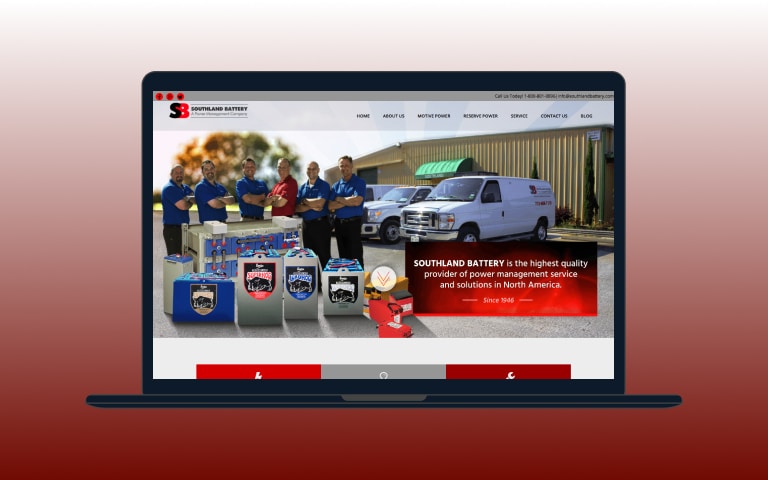
Southland Battery was an established industrial company with real customers, recognizable products, experienced leadership, and existing market demand.
Its website did not reflect any of that.
Like many long-standing industrial and manufacturing businesses, Southland had outgrown an older digital presence that made it harder for customers to understand the company, navigate its products, and take the next step.
IMPROZ rebuilt the experience from the brand outward—designing a new logo, creating original photography onsite, clarifying the company’s message, and developing a website that was easier to understand and use.
The result was one of our earliest examples of what would become the Branded Elite approach.
More importantly, the redesigned website produced one of the clearest early pieces of conversion evidence we had seen: Southland experienced roughly a 200% increase in website conversions.
That increase was not caused by suddenly tripling website traffic.
The demand was already there.
The new website simply did a much better job converting the attention Southland had already earned.
Redesigned an outdated industrial website around clearer messaging, navigation, usability, and functionality.
Developed a new Southland Battery logo and more cohesive brand presentation.
Planned and produced an onsite photography session featuring the actual owner, managers, trucks, uniforms, and business location.
Created product-focused visual storytelling using original photography and composited battery imagery.
Improved the website’s ability to convert existing brand and product demand.
Southland recorded an approximately 200% increase in website conversions after the redesign.
The company was later acquired by a much larger organization in the same industry, with the modernized brand and digital presence becoming an important part of how Southland presented its business value.
Industry: Industrial Battery Products and Services
Services Provided: Brand Development, Logo Design, Custom Photography, Website Strategy and Design, Product Messaging, Navigation and UX Improvement, Conversion-Focused Website Development
Goal: Replace an outdated digital presence with a professional brand and website capable of better representing the company and converting the demand Southland had already earned.
Southland Battery became one of IMPROZ’s earliest Branded Elite projects.
The opportunity went far beyond making an old website look newer.
Southland already had a functioning business, established relationships, experienced people, branded vehicles, products, and customers searching for what the company provided.
What it lacked was a digital experience that communicated that strength.
The project became an early demonstration of a lesson we have seen repeatedly with industrial businesses:
A company can be much stronger than its website makes it appear.
Southland did not need a website to make the company legitimate.
The company was already legitimate.
Its owner and managers were experienced. Its trucks were on the road. Customers knew the brand. Products were being searched. Business was already happening.
But the website did not communicate that reality.
An outdated presentation, weak organization, unclear messaging, and limited usability created unnecessary friction between customer interest and customer action.
For a visitor who did not already know Southland well, the website made the business harder to understand than it needed to be.
The company had earned credibility offline.
The website needed to stop hiding it.
One of the most important lessons from the Southland project came after launch.
Conversions increased by roughly 200%.
It would be easy to look at that result and assume the redesign suddenly generated dramatically more traffic.
That was not the important change.
Southland already had people searching for the company, its products, and the solutions it provided.
The larger opportunity was improving what happened after those people reached the website.
Clearer messaging helped visitors understand the offer.
Better navigation made products and information easier to find.
Improved usability reduced friction.
Stronger functionality gave visitors a more practical way to interact with the business.
The redesign did not have to create all of the demand.
It had to stop wasting it.
Southland was not a generic industrial operation, and we did not want its website to look like one.
Rather than building the visual identity from stock photography, IMPROZ planned a shoot at the company’s actual location.
The owner and managers appearing in the photography were the real people running the business.
The details were deliberate.
The trucks were washed.
The team wore company shirts.
The shoot was timed around the available light.
The location itself became part of the story.
Battery imagery was later composited into the photographs to strengthen the product narrative while preserving the authenticity of the original scene.
The goal was not merely to make the website look more polished.
It was to make the digital brand feel connected to the company customers would actually encounter.
Southland also represented a broader opportunity IMPROZ continues to see across industrial and manufacturing markets.
Many established companies have operated successfully for years while giving relatively little attention to their websites.
Some have outdated designs.
Others have poor mobile experiences, confusing product structures, weak messaging, or limited functionality.
Some barely have a website at all.
That does not necessarily mean those businesses lack demand.
Sometimes it means their digital infrastructure has never caught up with the company they have already built.
Southland showed what can happen when it finally does.
We approached Southland as a business and brand problem—not simply a design project.
The objective was to make the website represent the real company more accurately while making it easier for existing and prospective customers to understand its products and take action.
IMPROZ developed a new Southland Battery logo and visual direction intended to give the business a more professional and cohesive identity.
The brand was then carried into the website so the visual presentation, messaging, people, vehicles, and products felt connected rather than assembled from unrelated pieces.
This was an early example of the philosophy behind Branded Elite:
The website should emerge from the identity of the business rather than forcing the business into a generic website template.
We staged and photographed Southland at its actual place of business.
The images featured the real owner and managers, the company’s trucks, branded clothing, and the physical environment surrounding the operation.
Timing and preparation mattered because the photography needed to communicate professionalism without feeling artificial.
Battery imagery was composited into selected photographs where it helped communicate the product story more clearly.
The finished visuals did more than decorate the site.
They gave customers visual evidence that there were real people, real operations, and a real company behind the website.
The redesign focused heavily on what visitors needed to understand and do.
Messaging had to become clearer.
Navigation had to become easier.
Products and capabilities had to be easier to locate.
The website needed to reduce the amount of interpretation required from the customer.
Instead of asking visitors to work through an outdated digital structure, the new experience created more direct pathways between interest, information, and action.
Southland’s biggest opportunity was not necessarily creating an entirely new audience. A meaningful amount of demand already existed.
The website needed to perform better when that demand arrived. That changed the definition of success.
Page clarity mattered.
Usability mattered.
Navigation mattered.
Functionality mattered.
Trust mattered.
Calls to action mattered.
The redesign concentrated those elements around a simple question:
When someone already interested in Southland reaches the website, are we making it easier or harder for them to become a customer?
Southland illustrates why website performance cannot be separated from the rest of the customer experience.
A business may already have strong word of mouth, repeat customers, product demand, referrals, and branded search activity.
If the website is confusing, dated, difficult to navigate, or poorly structured, some of that earned demand can disappear before it becomes an inquiry.
The redesign removed friction.
Visitors encountered a more professional brand.
They saw real people associated with the business.
They could understand the company and its products more easily.
They could move through the website more naturally.
And they had clearer ways to take action.
The approximately 200% improvement in conversions became meaningful evidence that the opportunity had not simply been “get more traffic.”
The opportunity was to do more with the traffic Southland already had.
That distinction matters enormously for mature industrial companies.
Marketing does not always begin with creating demand.
Sometimes it begins by discovering how much demand the existing website is failing to capture.
The new logo and visual system gave Southland a stronger professional presentation.
Customers were no longer encountering a digital experience that felt disconnected from the scale and maturity of the company behind it.
The brand helped close that gap.
The photography gave the website something stock imagery could not provide: evidence of the actual people and operation.
Customers could see the leadership, branded trucks, business environment, and professionalism of the organization.
That authenticity strengthened the broader presentation.
Clearer messaging and easier navigation reduced unnecessary friction.
A visitor already searching for Southland or its products could find information more efficiently and move toward the appropriate next step.
The conversion improvement showed why UX is not merely a design consideration.
Usability can directly affect whether existing interest becomes business.
Southland was later acquired by a much larger company operating in the same industry.
Following the acquisition, the original Southland website was eventually retired as the company became part of the larger organization. But the website had already served a larger purpose.
The modernized brand and digital presence became an important factor in how the business presented itself during that period. That gives the project a broader lesson.
A strong website can support marketing and sales, but for an established company it may also influence how customers, partners, employees, and potential acquirers perceive the business itself.
The Southland project provides several forms of evidence.
The visual work remains documented through IMPROZ’s portfolio imagery, including the custom brand photography and website walkthrough.
The photography itself documents a deliberate brand-development process built around Southland’s actual leadership, vehicles, location, and products rather than generic industrial imagery.
Most importantly, Southland recorded an approximately 200% increase in website conversions following the redesign.
That result should not be interpreted as proof that a new website automatically produces the same improvement for every business.
The Southland situation was particularly important because the company already had market recognition and existing demand.
The redesign improved the digital environment receiving that demand.
The later acquisition provides another chapter in the project.
Southland ultimately became part of a much larger industry company, and the original website was retired after the acquisition.
Its disappearance does not erase the value of the project.
It reflects what happened to the business itself.
Southland’s website served the company during an important stage of its growth, improved its ability to convert existing demand, and strengthened the professional presentation of the business before it entered its next chapter.
Many established industrial and manufacturing companies have built strong businesses without building equally strong digital experiences.
Customers know them.
Products are being searched.
Relationships already exist.
Revenue is already being generated.
Yet the website may still be years behind the business.
That gap can create more than an appearance problem.
It can make products harder to understand, create friction for customers, weaken trust, reduce conversions, and undersell the company to anyone evaluating the business for the first time.
Southland Battery demonstrated what can happen when the digital experience finally catches up.
Sometimes the fastest growth opportunity is not finding more demand. It is converting more of the demand you already earned.
