
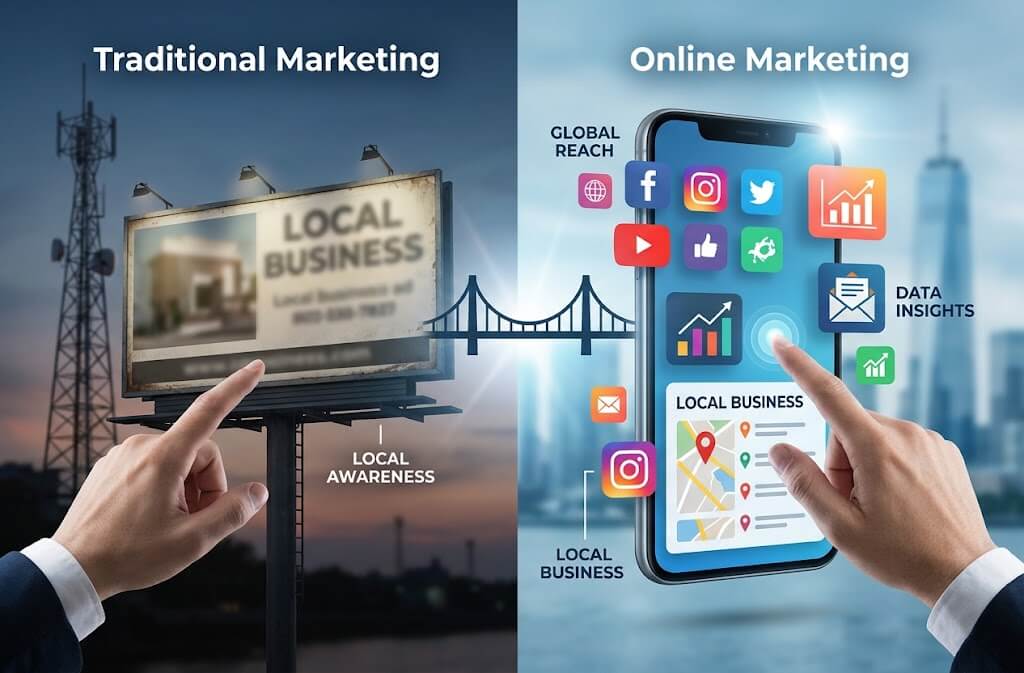
If your business relies on outdated marketing methods, you are missing out on the channels where your customers spend most of their time. The classic debate between online marketing and traditional marketing (like print, radio, and billboards) isn’t just about choosing one over the other anymore. It is about understanding how consumer behavior has fundamentally shifted.
While offline branding still holds hyper-local value, digital strategies offer a level of precision, scalability, and tracking that traditional media simply cannot match. To stay competitive, businesses must understand how the marketing landscape has evolved and where to effectively allocate their budgets today.
Marketing used to rely on a “broadcast” model—buying a billboard or a radio spot and hoping the right person noticed it among a massive, untargeted audience. Today, digital platforms have turned marketing into a two-way, data-driven conversation.
Audience Reach: Traditional channels limit you to a specific geographic broadcast or print run. Online marketing allows you to target users globally or drill down to a hyper-local neighborhood based on real-time behavior.
Consumer Trust: Static ads no longer carry the weight they used to. Modern consumers look for social proof. Peer recommendations, Google reviews, and social media shares act as digital word-of-mouth validation that traditional ads cannot replicate.
Engagement: A magazine ad stops at the page. Digital content keeps users engaged through interactive blogs, video content, and direct messaging, guiding them smoothly from discovery to purchase.
The digital tactics that worked a decade ago are no longer enough. Algorithms have matured, and customer expectations are higher than ever.
Years ago, digital marketing was heavily focused on raw volume—getting as many clicks, Facebook likes, or keyword repetitions as possible. Today, search engines and social platforms prioritize user intent, high-quality content, and authentic community engagement.
With the rise of AI-driven search, localized algorithms, and advanced privacy shifts, businesses can no longer rely on generic digital ads. Success now requires a highly tailored digital marketing strategy that targets the right user at the exact moment they are ready to buy.
The single largest advantage online marketing maintains over traditional media is its microscopic trackability. With traditional ads, calculating a precise return on investment (ROI) involves a lot of guesswork.
Modern digital analytics tools remove the mystery by allowing you to track exactly how your budget performs:
Traffic Sources: Identify precisely where your website visitors are coming from (e.g., organic search, paid ads, or social media platforms).
User Behavior: See exactly how long visitors stay on your pages and how they navigate your site.
Conversion Optimization: Track which specific calls-to-action (CTAs) convert casual browsers into paying customers, allowing you to constantly adjust your setup for maximum ROI.
We do not look at marketing as a one-size-fits-all solution. While traditional local awareness has its place in a broader brand strategy, building a dominant online presence is non-negotiable for sustainable business growth.
Whether you need to capture local search traffic with targeted local SEO services or build a high-converting digital storefront through expert website design support, your digital footprint must be cohesive, modern, and backed by data.
If you want to stop guessing where your leads are coming from and build a marketing system that scales, explore our website packages or request a tailored strategy outline today.