
If your website looks like a cluttered antique shop rather than a clean, modern digital storefront, it is likely costing you customers. A confusing layout, excessive design elements, and walls of text reduce trust and cause visitors to hit the back button instantly. Your audience needs to understand who you are and how you can help them within seconds of landing on your page.
Fortunately, achieving a professional web presence doesn’t require over-complicating your pages. Transitioning to a clean layout makes your website instantly more polished, informative, and high-converting.
Web design expectations have shifted drastically over the years. Understanding this shift helps explain why minimalist layouts consistently outperform busier alternatives.
The Old Way: In the past, businesses tried to crowd every piece of information onto the homepage. Websites relied heavily on sidebars, complex dropdown navigation menus, tracking counters, and heavy animations (like obsolete Flash elements) to grab attention.
The New Way: Today, clean design is tied directly to site speed, mobile responsiveness, and user intent. Modern users scroll naturally; they expect immediate clarity, fast load times, and an intuitive path to purchasing or contacting a business.
While design trends evolve, several foundational principles of an effective, simple website design remain unchanged.
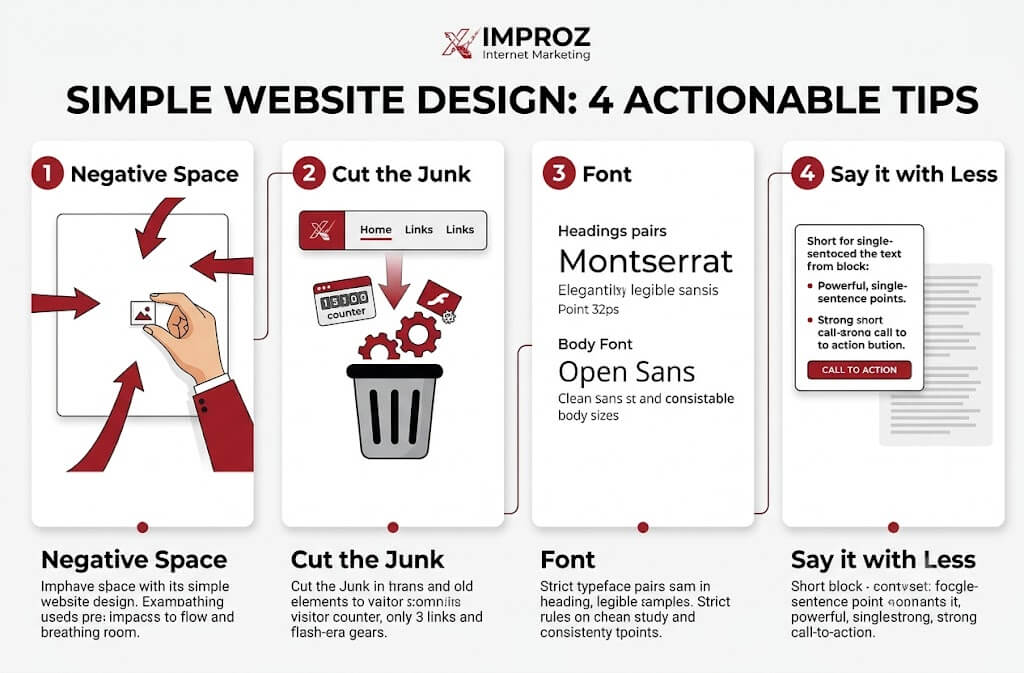
Negative space—the empty area around text and images—is not wasted space. It acts as visual breathing room. Just as an understated museum gallery allows you to appreciate individual pieces of art, wide margins and clean spacing guide a visitor’s eyes directly to your most important content and call-to-action (CTA) buttons.
A visitor should never have to guess how to find your services or contact info. Modern navigation should be brief and intuitive. Limit your primary menu to your most critical pages and eliminate unnecessary widgets or secondary sidebars that distract from your main message.
Your choice of fonts dictates your website’s readability. Stick to a strict rule of using no more than two or three fonts across your entire site—one for headings and one for body text. Ensure your font sizes are consistent and optimized for screen reading. Clean, sans-serif fonts typically offer the best readability on both desktop monitors and mobile devices.
Brevity is essential for digital copywriting. Long, multi-paragraph “About Us” pages rarely get read by busy consumers. Instead, focus on short paragraphs, clear benefits, and a natural layout. Make your message concise and focused entirely on solving your customer’s problems.
A clean website is no longer just an aesthetic choice—it is a core component of a successful digital marketing strategy. Modern search engines prioritize websites that load quickly and offer seamless mobile experiences. Cluttered sites slow down performance and frustrate users, directly harming your search rankings.
When building a high-performing site, every element must serve a distinct purpose. By eliminating visual noise, you make your primary business message stand out. If you are ready to modernize your online storefront, exploring professional website packages can help stream-line your digital presentation and turn casual traffic into loyal clients.